



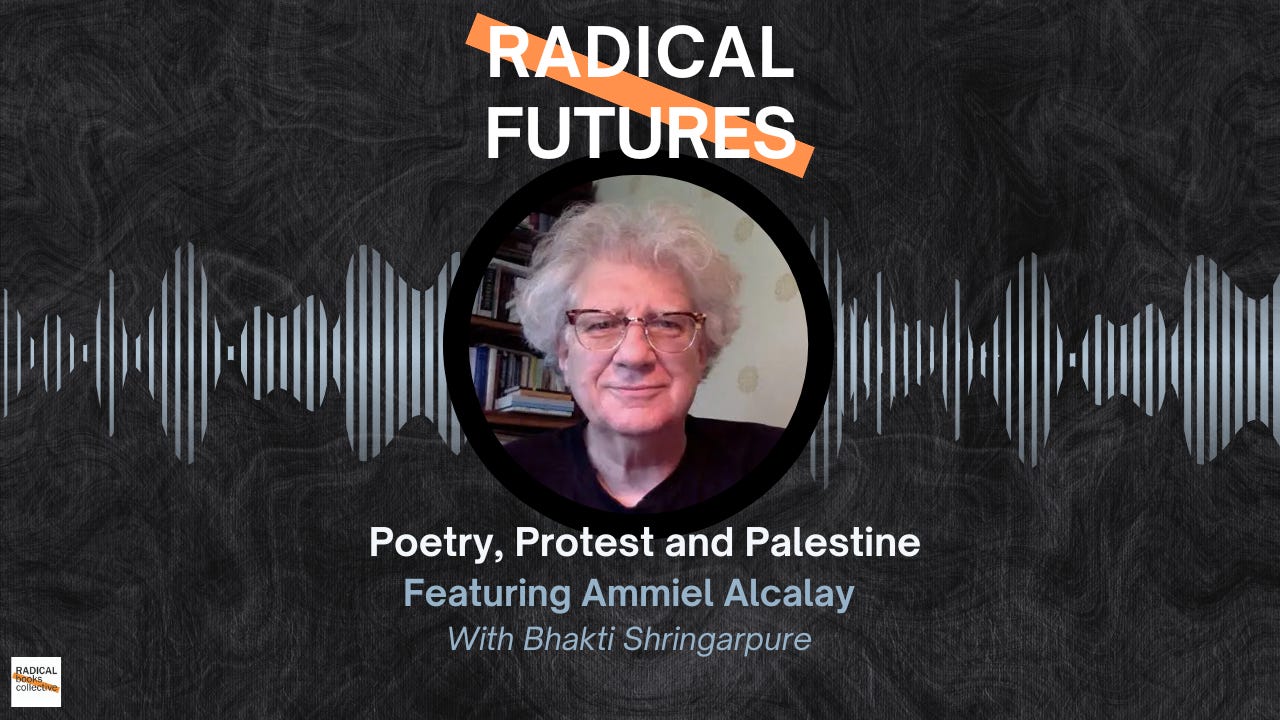
In more than two dozen books spanning Iraq, Bosnia, Palestine and Vietnam, poet, translator and scholar Ammiel Alcalay has crystallized a piercing critique of American imperialism. He illustrates a commitment to places and people upon whom the bloody trail left by American excursions is inscribed, whether abroad or at home.
Alcalay has crafted a unique insider-outsider approach grounded in poetic practice, a study of languages, and that embraces a wide range of materials: news, poems, letters, books, essays, reports, speeches, music, art, comics, radio, conversations, and more. His work goes against the grain of institutionalized forms of writing and allows for an excavation of political, historical and literary narratives that have been deliberately buried, obfuscated and redirected.
Our conversation was wide-ranging, yet focused on historicizing and contextualizing the present moment as genocide continues in Palestine, as American universities unravel with shocking speed, and as the grip of authoritarianism and fascism tightens worldwide. When it comes to Palestine, Alcalay reflects on past events that have created the material conditions for the genocide to take place with full global complicity, all in the bright light of day.
From 2018 onwards, he says, the world has been in a state of immense tumult, with demonstrations in Lebanon, Chile, Columbia, Hong Kong playing out alongside the Hirak protests in Algeria and the Great March of Return in Gaza.
“Suddenly, boom, coronavirus - everything shuts down,” Alcalay says. “Enormous freedom of movement curtailed.”
He adds that Gaza was very much on his mind as he realized that these social movements and their ensuing suppression would create resounding and long-lasting reverberations that would likely become compounded in Gaza. He was right. It is clear, as he says: “We’re all heading to Gaza. That’s the model for the world.”
The “Gaza model” evokes what Aime Cesaire called the “imperial boomerang” whereby empire’s violence abroad inescapably boomerangs its way back home. Examples abound as terrorizing ICE agents roam the streets in the US and brutal practices of incarceration in North America, Europe and Asia mimic Israel to a fault.
For Alcalay, however, one has to go even further back to understand the “Gaza model.”
“The war in Iraq is a gaping hole in US behavior, thought, culture, politics, etc. It’s like a blast crater, and so many of the things that have been happening in Gaza -- withholding of food -- all of that happened in Iraq, was done by the US, and they killed hundreds of thousands. And the general culture has no clue whatsoever about any of that.”
To a large degree, American wars in the Gulf, and the amount of violence inflicted on Iraq through sanctions and “shock and awe,” have rarely penetrated the public psyche. Gaza has shocked the world, Alcalay explains, not only because these forms of brutalization have been obscured from the public, but also because of the horrifying speed and quantity with which they are being deployed. And simultaneously, the culture of protests has also changed over the years. The protests trying to stop the American invasions of Iraq and Afghanistan after 9/11 lacked the immediacy and collectivity that was present during the war in Vietnam, proving that modes of control and surveillance have successfully proliferated. The vicious and swift suppression of pro-Palestinian protests in the last two years is proof.
Despite these sombre assessments, Alcalay continues writing, translating and teaching. He has been buoyed by the success of Palestinian poet Mosab Abu Toha, since Alcalay was instrumental in bringing him to an American audience. In particular, he has been furiously translating and collaborating creatively with writers in Gaza.
“This is a big year for books,” Alcalay says. He co-translated Nasser Rabah’s poems, and the volume Gaza: The Poem Said Its Piece was published by City Lights books this year. He is awaiting the publication of the translation of a work by Alaa Radwan, a student of the late Refaat Alareer, and his collaborative book titled Imperial Abhorrences created with Gazan artist Kholoud Hammad is forthcoming.
Further reading:
—Controlled Demolition: a work in four books by Ammiel Alcalay https://asterismbooks.com/product/controlled-demolition-ammiel-alcalay
—After Jews and Arabs: Remaking Levantine Culture by Ammiel Alcalay
https://www.upress.umn.edu/9780816621552/after-jews-and-arabs/
Hosted by Bhakti Shringarpure.
Edited by Agatha Jamari
Radical Futures is produced by Warscapes
Title Music: “Cottonstorm” by Bayern Boom Beat
Subscribe | Follow www.radicalbookscollective.com


