


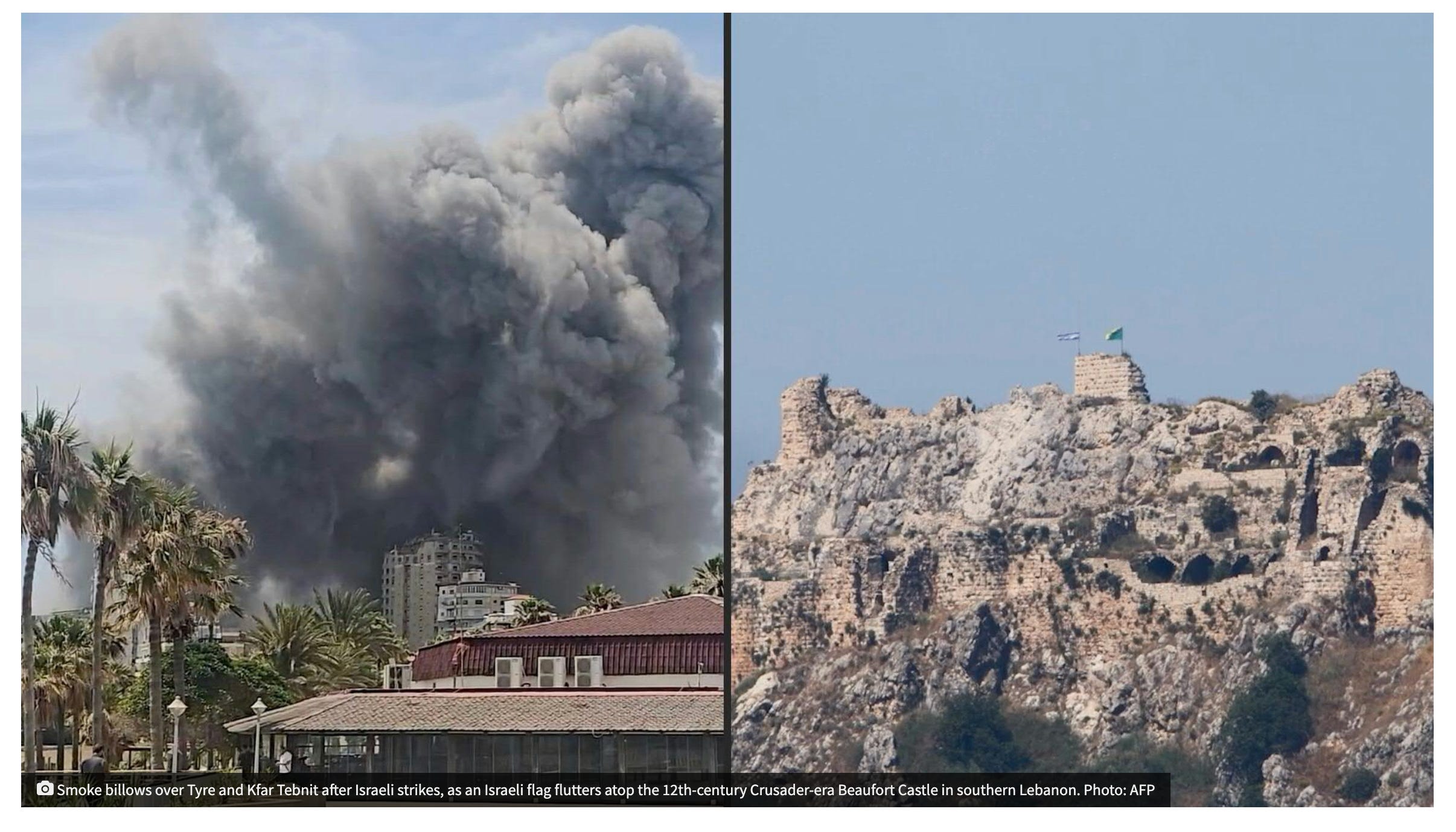
I am always ashamed when I mourn the destruction of monuments. How dare I indulge and grieve empty historical sites when actual human beings are being blown up into bits? All these questions surface as the weekend-long bombing of the 5000-year old city of Tyre in Lebanon has left ancient sites destroyed and several dozen dead.
Palestine’s greatest griot Mahmoud Darwish has a poem titled “The house murdered” (translated here by Fady Joudah) that reconciles the dilemma. Darwish contemplates the whole life of a house, a world that vanishes within one minute of a strike. It is a simple reversal of perspective. An attempt to contemplate life through objects that may seem lifeless. “In each thing there’s a being that aches...the memory of fingers, of a scent, of an image. And houses get murdered just as their residents get murdered. And as the memory of things get murdered—wood, stone, glass, iron, cement—they all scatter in fragments like beings.” We must seek meaning, memories, history, breath in these fragments.
Darwish makes a list of things that scatter, break, shard as a bomb bursts through: “And the lease contract, the marriage and birth certificates, the utility bills, identity cards, passports, love letters, all torn to shreds like the hearts of their owners. And the pictures fly, the toothbrushes, hair combs, make-up accessories, shoes, underwear, sheets, towels, like family secrets hung in public, in ruin.”
Everywhere we turn, a ruin.
Strikes on Qeshm and Goruk in Iran; strikes all over Lebanon; strikes as always in Gaza; Dutch police strike a pregnant Palestinian women; police strike and arrest over 700 people all over France for celebrating football match victory; German police draw guns at pro-Palestine protesters; police strike protesters outside an ICE detention center in New Jersey and a mayor imposes a curfew; police strike furious protesters who wanted bury their dead from Ebola in Democratic Republic of Congo; police strike anti-goverment protesters in La Paz, Bolivia, etc. Rinse and repeat.
Same news, different place. A world rising up. A world struck down.
I have nothing meaningful to say about what we can do anymore but I take solace in South African writer Sisonke Msimang’s words from almost a year ago: “The role of everybody is to be at the front lines of fighting for justice, right? There is a demand as a human being to show up in the world in particular ways, which is always difficult. It’s difficult in all times to show up with honesty and integrity in the world. And then in a time of genocide, it is more important than ever.”
The world is in a crisis so acute and so massive that every solution on the table and every strategy of resistance feels like we’re trying to put square pegs in round holes. The savagery and hatred at the core of all this is profound that there we are in a perennial state of cognitive vertigo. But we have to keep trying, we have to keep at it.
Love and solidarity❤️🔥
Bhakti Shringarpure
There has been a lot of activity at the Radical Books Collective. We’ve had so many wonderful guests and conversations. I’ve been terrible at sending out updates but please check these out!
—Two incredibly illuminating conversations on Sudan and Palestine, and the role of the media:
—Our Books Clubs are back and rolling! We had two conversations; one on the evils of Disney and another on forests in African novels:
I live the bookclubs. But why can’t you use the zoom platform rather than
youtube.