


Joe Sacco’s book Palestine: A Nation Occupied was my first true immersion into the history of Palestine. Over two and half decades later, I was overjoyed and honored to speak with him for the Radical Futures podcast. He spoke about his heartbreak over Gaza, his disillusionment with American journalism, his recent brush with censorship in India, and his forthcoming book Requiem for Gaza, co-authored with Chris Hedges.
Sacco admits that he began to clash with many of the existing principles of journalism early in his career. He had graduated with a degree in journalism from a university in the US and had begun following the coverage of Israel’s invasion of Lebanon in 1982. As news of the massacres of Palestinians in the Sabra and Shatila refugee camps reached him, he had an epiphany: “I remember seeing the photographs and looking at all this, and the thought that came to my mind is, ‘Wait a minute, I thought the Palestinians were the terrorists.’” Surprised by his own realization, Sacco resolved to interrogate this assumption about Palestinians that seemed to always hang in the air. He found himself in the West Bank, and eventually in Gaza, and his experiences became the foundation for a longstanding relationship with the region.
Along the way, Sacco blazed a trail with a new style of journalism: fusing cartoons with in-depth reportage and historical research. His first book Palestine: A Nation Occupied was published by Fantagraphic Books in 1993. Visually stunning, witty and incredibly moving, it was a groundbreaking for its commitment to detailed, on-the-ground reporting while offering a glimpse into a besieged community.
Sacco continued to report from war zones, and books on Palestine and Bosnia followed. He had grown up with parents who lived through heavy bombings during World War II in Malta, and their experiences of war and displacement have remained at the core of his work: “They lived under very desperate conditions, very little food. Malta was basically surrounded by German and Italian forces. They saw a lot and lived through a lot, and those are the stories I heard around the dinner table.” Perhaps this is also why engaging with history came naturally to Sacco.
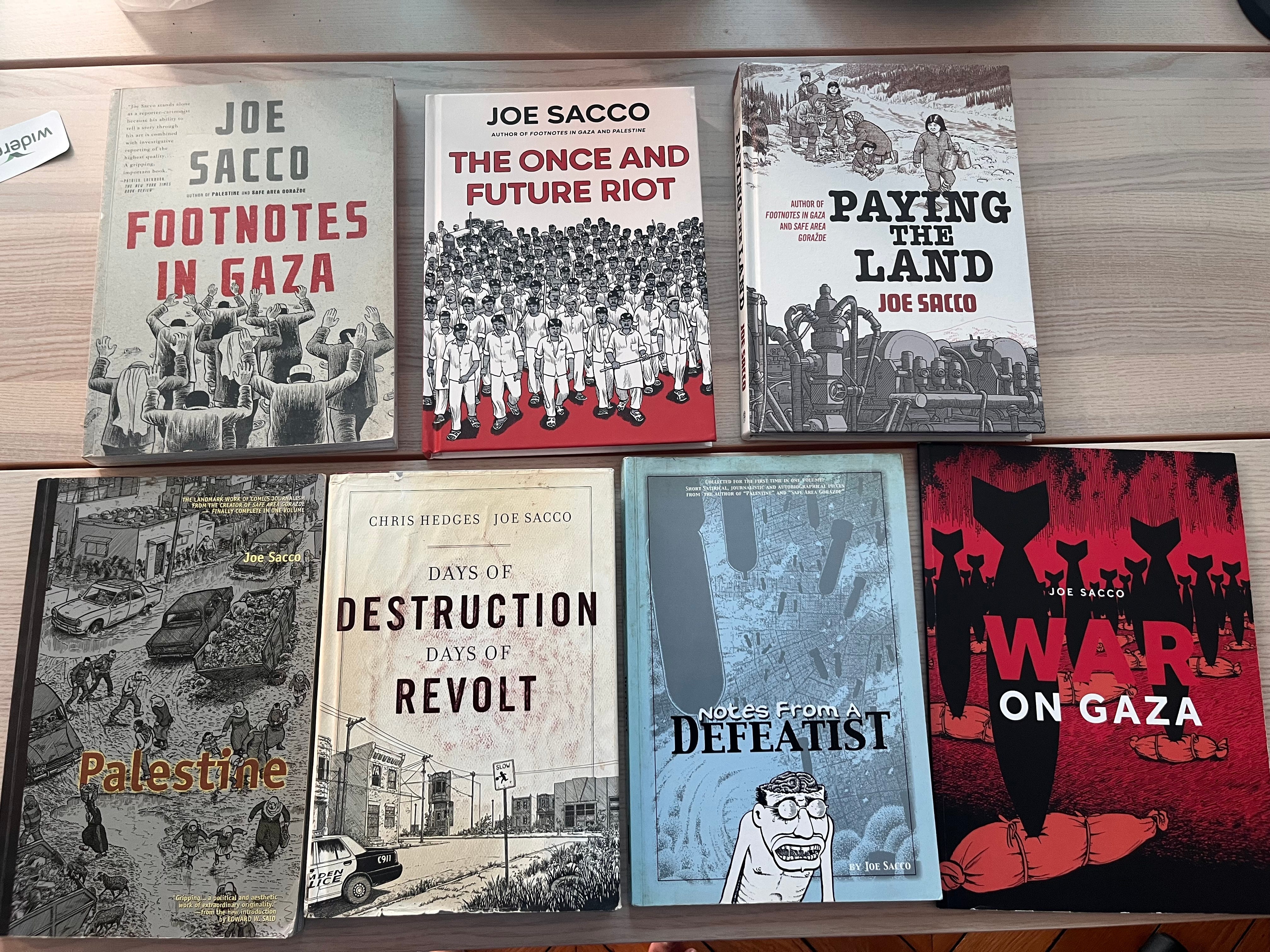
He produced works on the 1956 massacres in Gaza (Footnotes in Gaza, 2009); a powerful book on poverty in the US in collaboration with Hedges (Days of Destructions, Days of Revolt, 2012); an account of the Dene community living in the subarctic Canadian Northwest Territories (Paying the Land, 2020); and a controversial work on the deadly sectarian violence in northern India in 2013 (Once and Future Riot, 2026).
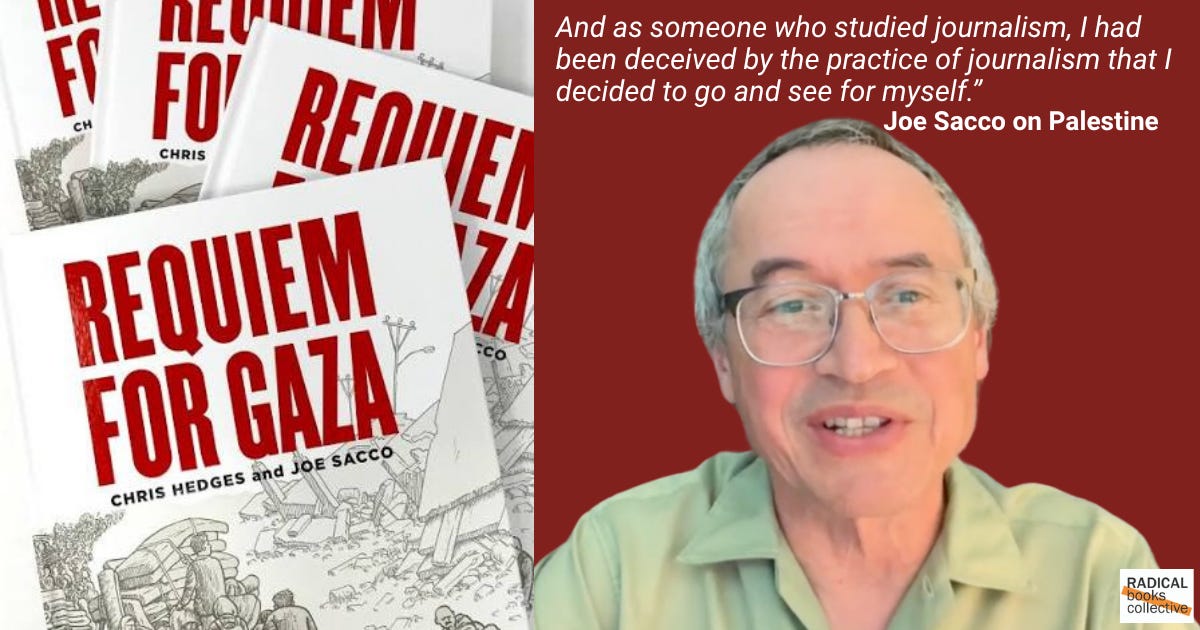
This month, Sacco will publish his third long work on Palestine, titled Requiem for Gaza and co-authored again with Hedges. Distraught about the last two years of genocide, and with no real possibility of entering Gaza, Sacco and Hedges spoke with 29 families who had escaped to Egypt. In Gaza, “all means of life have been extinguished,” he said. “I mean, purposefully destroyed, not accidentally destroyed, but in many, many cases dynamited.”
In this conversation, Sacco opens up about a range of topics with charm and self-effacing humor : his journey as a self-taught cartoonist, how the subject might shape his drawing style, and his long historical works that take years to complete.
Love and solidarity❤️🔥
Bhakti Shringarpure
Further reading:
Requiem for Gaza by Joe Sacco and Chris Hedges, Fantagraphics, 2026.
https://www.fantagraphics.com/products/requiem-for-gaza
Listen | Watch👇🏾
28. Palestine and the Collapse of American Journalism: Featuring Joe Sacco

Joe Sacco admits that he began to clash with many of the existing principles of journalism early in his career. He had graduated with a degree in journalism from a university in the US and had begun following the coverage of Israel’s invasion of Lebanon in 1982.
Summer highlights from the Radical Books Collective
How To Date A Fanatic Book Club with Aruni Kashyap

Aruni Kashyap in conversation with Bhakti Shringarpure about How To Date A Fanatic, queer campus novel about a group of characters whose lives are torn asunder by right-wing political violence in northern India.
'Homosexual Intifada' Book Club with editors Hannah Moushabeck & George Abraham

A powerful conversation about a groundbreaking anthology! Editors Hannah Moushabeck and George Abraham spoke with Bhakti Shringarpure about Homosexual Intifada, a powerful anthology spotlighting the voices of queer Palestinian writers from both the diaspora and homeland.
Breathe In, Breathe Out, Shoot to Kill: Women, Wellness & Fascism

Alyson K. Spurgas, Madhuri Sastry and Bhakti Shringarpure unpack the dark side of wellness, self-care and yoga industries.
How Artificial is Too Artificial? Writing, Publishing & Teaching in the Age of AI

Aruni Kashyap, Madhuri Sastry and Bhakti Shringarpure discuss the rapidly increasing presence of AI which is causing a cognitive vertigo. Love it, hate it, need it or resist it, there is no denying that the pervasive presence of AI in all aspects of life has caused an upheaval. It is easy to denounce the use of AI in technologies of warfare and to rail …
For those who haven’t seen Chris Hedges talking to Joe Sacco here’s the link
👇🏽👇🏽👇🏽
https://youtu.be/fnrzKUBt9vU?si=H6S-4-u18XzBfdm6