


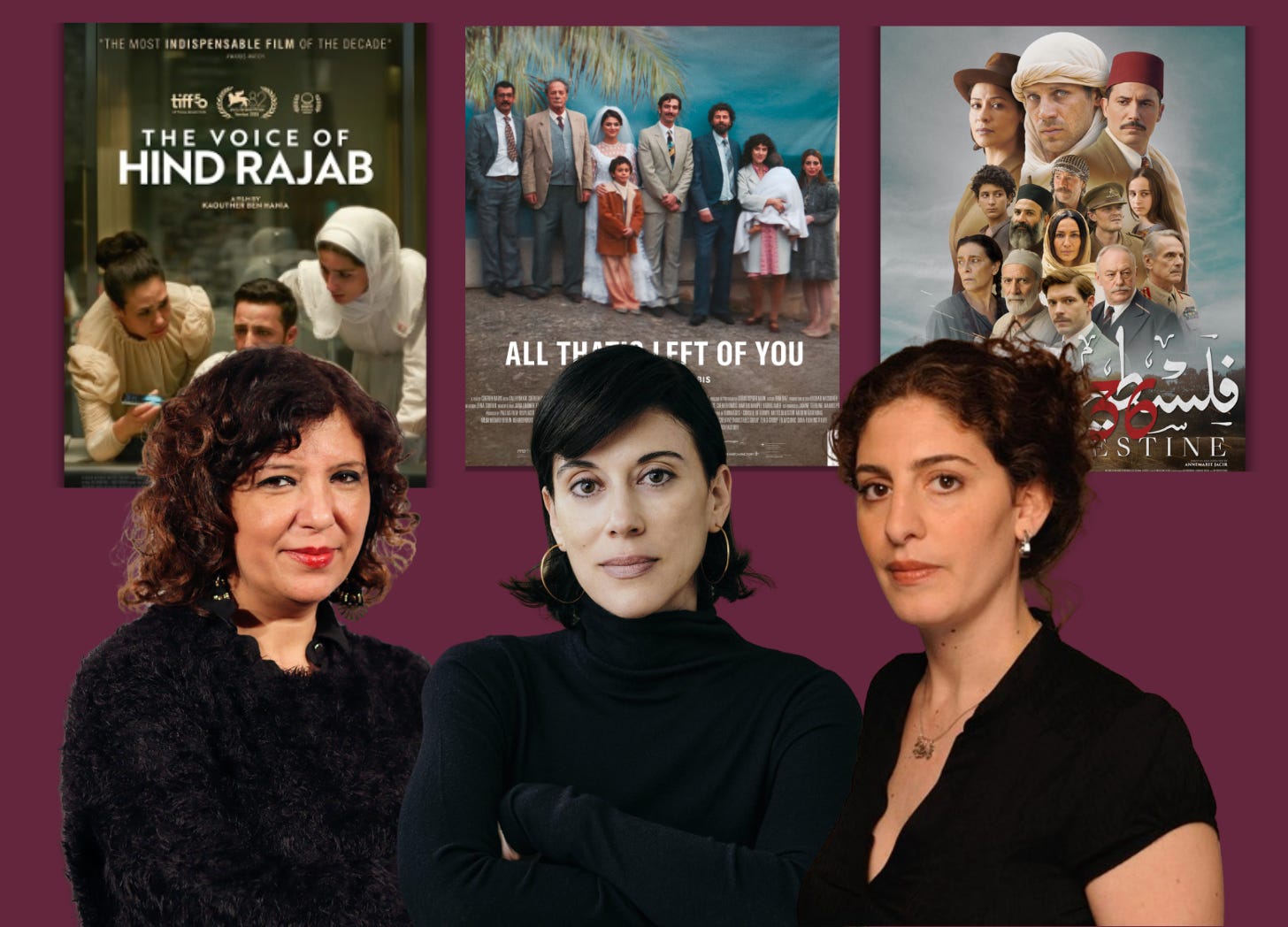
Three powerful Palestinian films have pierced through to the public imagination this past year: Palestine 36, All That’s Left of You, and The Voice of Hind Rajab.
These films have landed with precision timing. Adding more muscle to the phenomenal convergence of their releases is the fact that they were all made by cinematic heavyweights and prolific women directors of Arab heritage: Annemarie Jacir, Cherien Dabis and Kaouther Ben Hania. Palestinian films and documentaries have been trickling in steadily for the last many years, and unsurprisingly, there has now been an uptick as genocide and war continues to devastate Palestine. But these three films are particularly important because they are making urgent interventions in a highly contested and maligned area: history.
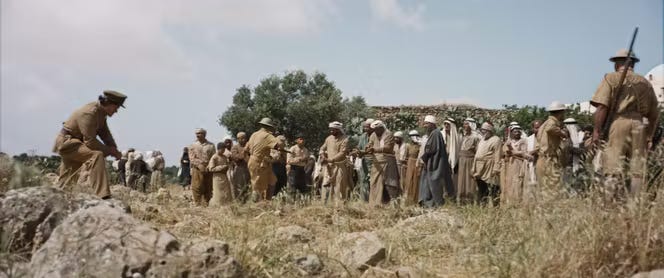
Palestine 36, directed by Jacir, is an epic historical saga, looking back the farthest in terms of time. It tells the story of Palestinian revolt from 1936-1939 against British colonial rule, and the ways in which it enabled and structured the Zionist occupation that followed. Told through a large ensemble cast of real and fictional characters, the film does a tremendous job of backdating the story of Palestine and rescuing it from strategic historical amnesia. Today, the worst of them insist that Palestinian history began on October 7th, 2023, the both-siders can barely make their way past the Oslo Accords of the nineties, and even the best of them see the Nakba of 1948 as the farthest point. Sadly, our collective colonized minds are unable to imagine the verdant, diverse, modern and populated Palestine from before 1948. And Palestine 36 steps in right here and shows us (through breathtaking panoramic cinematography) that beautiful before. But it won’t last long, and the film focuses on the exact moment of settler colonial rupture and the power of the uprising that unleashes a bulwark of resistance.
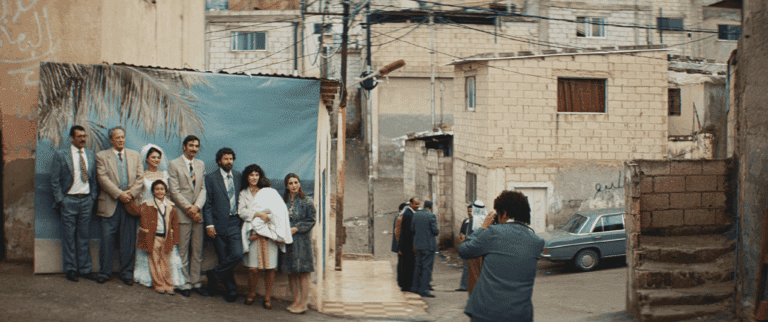
All That’s Left of You by Dabis is also an epic saga, but its historical intervention happens through the story of one family followed over three generations. The first rupture comes in 1948, when a well-to-do family of orange farmers in Jaffa are forced out of their home by Zionist militias. The patriarch Sharif endures a labor camp as his wife and children escape to Nablus in the West Bank. Through the shocked child gaze of Salim, we see the Nakba laid out over the vast countryside as lines of weary people with a few belongings make their way to refugee camps. The family’s fall from grace is immediate as prosperity, comfort and dignity are never to return. The next generation is the main focus of the film, as Salim and Hanan cobble together a modest life under occupation.
At the core of the film is the story of their son Noor. Young, energetic and tempestuous, he is shot during a protest, thus leading his parents down an arduous, nail-biting journey of permits and passes—the inhumane apparatus of the apartheid system— in order to get him medical help. Not only does the viewer see intergenerational trauma actualized on the screen, we also see the landscapes and the cities change over the years as Israel settles, pillages and occupies Palestine. All That’s Left of You documents various historical shifts over a period of 76 years (1948-2022) but it is also invested in showing the geographical mutilation of the land itself. Time, place and psyche merge beautifully in this emotionally charged family story.
The Voice of Hind Rajab by Ben Hania departs stylistically and narratively from the other two, but makes the most timely intervention of them all. The true story cuts through the morass of propaganda around the 5-year old girl, Hind Rajab, who was slaughtered along with her family on January 29, 2024, as the Israeli army pumped 355 bullets into their small car. In a brilliant move, Ben Hania sets the entire film in the office of the Palestinian Red Crescent in the West Bank, as a small crew of emergency responders attempt to rescue Hind, almost a hundred kilometres away and with the entirety of Israel in between. A master of the “cinematic documentary” genre, Ben Hania uses excerpts from real audio tapes from the calls that lasted for several hours as Hind was alone in the car with her family slain, an Israeli tank lurking next to her. As night falls, the emergency responders begin to come undone listening to the little girl plead with them.
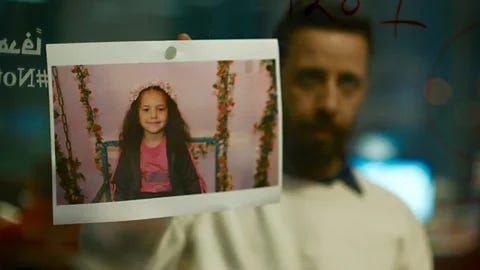
The film resurrects the entire timeline of the assassination but also educates the viewer about the impossibility of the work of emergency responders and paramedics who require permits from Israel itself to be able to send in rescue teams. The film proves unequivocally that the Israeli army would have known that the car only had a little girl inside, and that the Israeli government coordinating agency did not allow rescue teams to come get her despite them being few metres away. When the rescue vehicle did approach, the IDF shelled it and killed the two paramedics (Yusuf al-Zeino and Ahmed al-Madhoun) as well. The film shows the characters experience acute secondary trauma as little Hind’s fear and distress are transmitted through the phone. We, the viewer, must confront two levels of trauma, Hind’s and of the responders. Somehow, perhaps through sheer narrative heft, Ben Hania pushes us and holds us enclosed within the office room as we soak the stress of the responders and become activated to help Hind.
In fact, my admiration for The Voice of Hind Rajab stems from its ability to “activate” us on a broader level. The genocide of Palestinians has been broadcast on our screens and our minds have become saturated with images of mangled bodies. Ben Hania’s intervention, focused on the level of sound, moves away from the abject and heartbreaking visuals we have become accustomed to. In doing so, the film offers a new framework for engaging with and understanding everything that is happening in Palestine. Most people I spoke with refuse to see the film because they are worried it will emotionally wreck them. I felt similarly until I finally just went and saw it. It is certainly an intense experience but not because it is trauma porn nor because of any gory visuals, but because once you watch the film, the truth about Israel’s sickness and brutality becomes undeniable.
The Voice of Hind Rajab might be my standout favorite, but the three films must be taken as a triptych, which means they should all be viewed for full effect. Even though the three directors have worked on their own at different times and in different places, the confluence of timing in our current moment, the overlapping themes, the stylistic interchanges, the impetus for historical correctives, and the urgency for Palestinian representation cannot be emphasized enough.
Certainly, these are not films without flaws. Palestine 36 attempts to do too much, and it becomes harder to get closer to the characters and their journeys. Despite belonging to the genre of epic historical sagas like Gandhi, Doctor Zhivago or the innumerable films about European World Wars and the Jewish Holocaust, Palestine 36 is only 1 hour 59 minutes long. At a time when meaningless violent blockbuster franchises like Avatar or Marvel shamelessly make 3-hour films, Jacir’s decision to keep the film under two hours is painful because it feels abrupt. I would have willingly sat through another hour as would have most filmgoers.
Meanwhile All That’s Left of You overindulges the narrative and the characters’ journeys, and does not entirely earn its 2 hours and 30 minutes runtime. The film attempts dialogue with an Israeli character, which might be a noble goal in itself, but comes off as overwrought. The plot is also too tidily resolved for a story that is trying to capture the precarity of Palestinian lives.
The Voice of Hind Rajab takes on a difficult task of telling the viewer a story they already know: that Hind will not survive. Even as it holds our attention, it does sometimes give a feeling of false endings, a sense of reaching the finale a couple of times before the actual climax of the film.
My mild critiques pale in comparison to the hurdles the directors have faced in making the films and in getting them out into the world. Jacir and Dabis had to overhaul their production schedules as the genocide began to unfold. Jacir insisted on continuing filming in the West Bank which had become a complete war zone by that time. Similarly Dabis had to shift entire sets to new locations and cope with relentless logistical nightmares. In a world designed to exclude Palestinians and their stories, the filming challenges become microcosms that illustrate this existential peril. At some meta level, it is not a surprise that Ben Hania has made the most perfect film out of the three, because the compressed narrative filmed entirely in one room in France meant that her process was not interrupted. Jacir and Dabis, both of Palestinian heritage, had far bigger ambitions and lived the structural disorder that the Israelis plunged the world into during the filming.
Once the films were complete, the next round of hurdles began. All three films have had trouble finding distributors, thanks to the gatekeeping power of white and Jewish supremacy in the film industry. The Western film industry is divided over the genocide in Palestine at a time when Palestinian films, books, essays, festivals, events, and even the word “Palestine,” have become explosive utterances. For the most part, the films have been shut out of mainstream awards, acclaim and reviews circuits. Thanks to the might of few Hollywood celebrities and the film’s raw power, The Voice of Hind Rajab has an Oscar nomination, but with the Oscars famously known for celebrating epic scale cinema, it is pretty revealing that the other two films are not in the running. Palestinian narratives are under relentless attack, but these films’ capacities to overcome the hatred, the disses, the bad write-ups and the attempts to keep them invisible are proof that we are in a very new and rapidly shifting cultural terrain.
Palestinian cinema has a long and prestigious history, and one that I was introduced to as a young grad student in New York City in 2003. I had attended “Dreams of a Nation: A Palestinian Film Festival” organized at Columbia University, and the opening night featured a keynote address by none other than the incredible Edward Said. The festival, whether deliberately or not, was responding to a particularly fraught post-9/11 moment that was marked by the vilification of Muslims, rampant censorship and the loud calls for wars in Iraq and Afghanistan. Sound familiar?
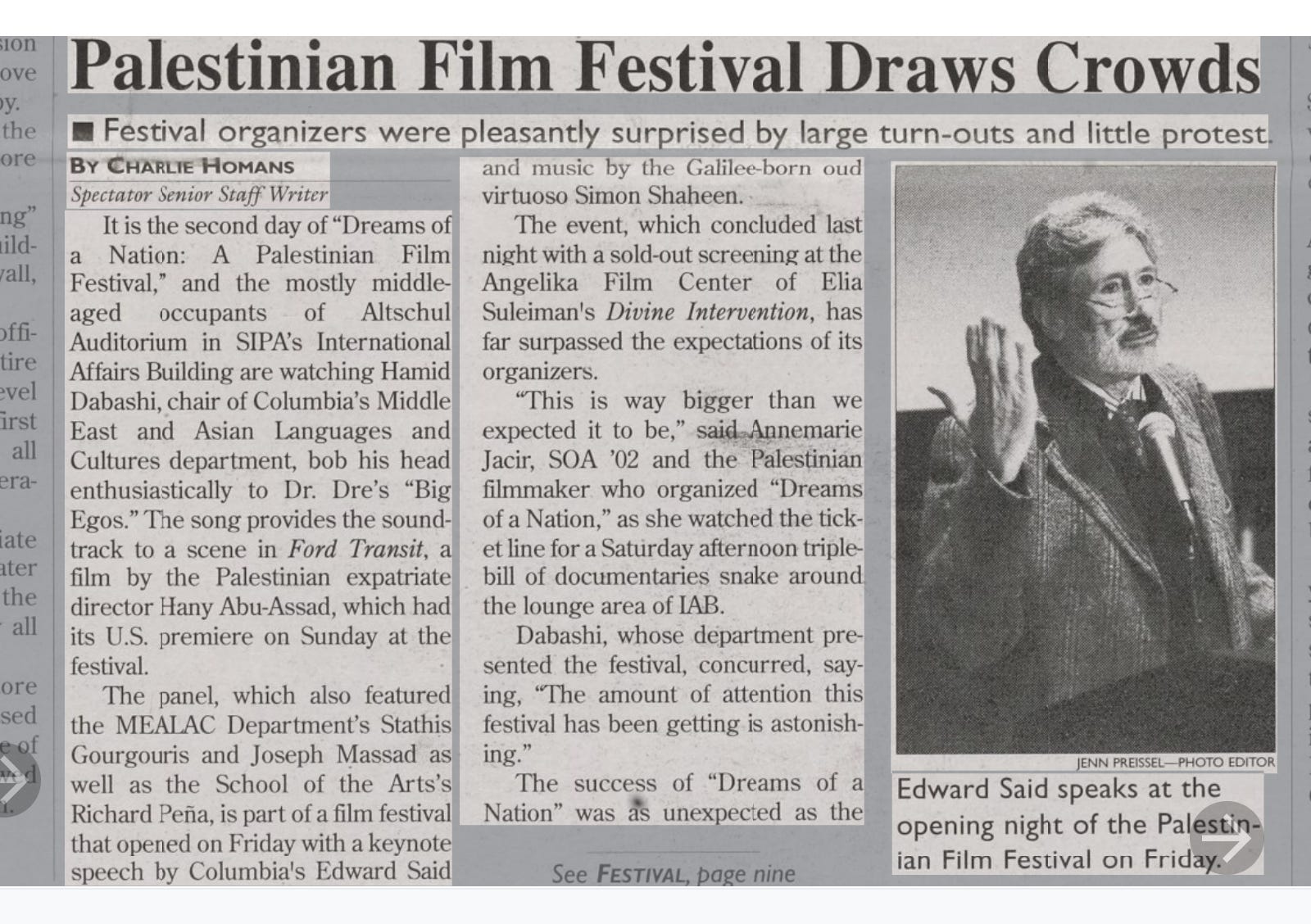
During this terrifying time, it was things like film screenings, poetry readings and book groups that kept me going. They fed me, because these stories, discussions and visuals were the only available counter-narratives to relentless racist, Zionist and white supremacist propaganda that had overtaken the mainstream. As always, and as it is right now, when political, legal and media institutions fail us either by coming apart at the seams or by peddling the state’s agenda, culture becomes the most vital, the most creative and most resistant space of intervention.
The genocide in Palestine that has been globally broadcast on social media has exposed the shocking lengths to which the Western film industry has gone to cover it up and to shove it under its red carpets. This is an industry driven by gatekeeping in the name of taste-making and artistic merit. Despite the hurdles, these three films have managed to get financial backing from the few pro-Palestinian funders, and have ended up in some festivals. They have been lifted up by progressive media outlets, and have had some celebrity amplification. The films are haltingly and painfully making their way into movie theatres and streaming services.
All this proves that the battle is always fought at the cultural level. Without being too academic about it, culture is quite simply the ideas, beliefs and values of a group of people as learned in schools, through books, films, TV, music, food, and through socialization and conversations. Political and legal actions don’t exist in a vacuum but are directly influenced by the language, the mood, the visuals and the overall spirit of the cultural moment. When we rush to blame all our current ills on individual tyrants or racist juries or unwilling power brokers, we forget these are shaped by the culture of the schools they attended, the movies and TV they watched, and the music they listened to.
Almost identical to our moment today, back in the early 2000s, political and legal institutions were coming apart at the seams. International law was being dismantled as torture and unlawful detention in Guantánamo become operative, and the Patriot Act was in full effect. Large international organizations like the UN were just as flaccid and powerless as now when Muslims were being hunted down on campuses, in their homes, at work, on flights, in their cars. In retrospect, it was clear that this push for the dehumanization of large swathes of people across several countries happened because the relentless, racist, Zionist and white supremacist propaganda had one true ally: mainstream culture.
Even in the darkest of times, the scariest of moments, and when nothing seems to make sense, a radical, alternative and counter-narrative culture steps up. World history is a literal repository of narratives of resistance emerging out of tyrannies, dictatorships, fascisms and genocides. Predicting how any cultural narratives move and multiply has never been an exact science, even for those with vast resources. Even when these cultural artefacts only impact a small group of people in the tiniest of spheres, they make a dent in the dominant realms by exposing the fissures, the lies and the cover-ups. And this is why culture work matters.
Love and solidarity❤️🔥
Bhakti Shringarpure
For more film chatter! Our pre-Oscars round-up of an unusual and interesting year in film includes the highs and lows, deep dives, take-downs, praise and predictions.
Well said, Bhakti. I’ve just seen Palestine ‘36, which I loved, and need to see the others. As you describe, I’ve been avoiding The Voice of Hind Rajab because the recording broke me so utterly when I heard it in the aftermath of the murder itself, but your review is reminding me why such a film is urgently important.
Just finished The Voice of Hind Rajab. Such a powerful movie. The shots in the small dispatch space was used so well. 😭 I remember when her story first came to the West. Such a heartbreaking story. Free Palestine.