


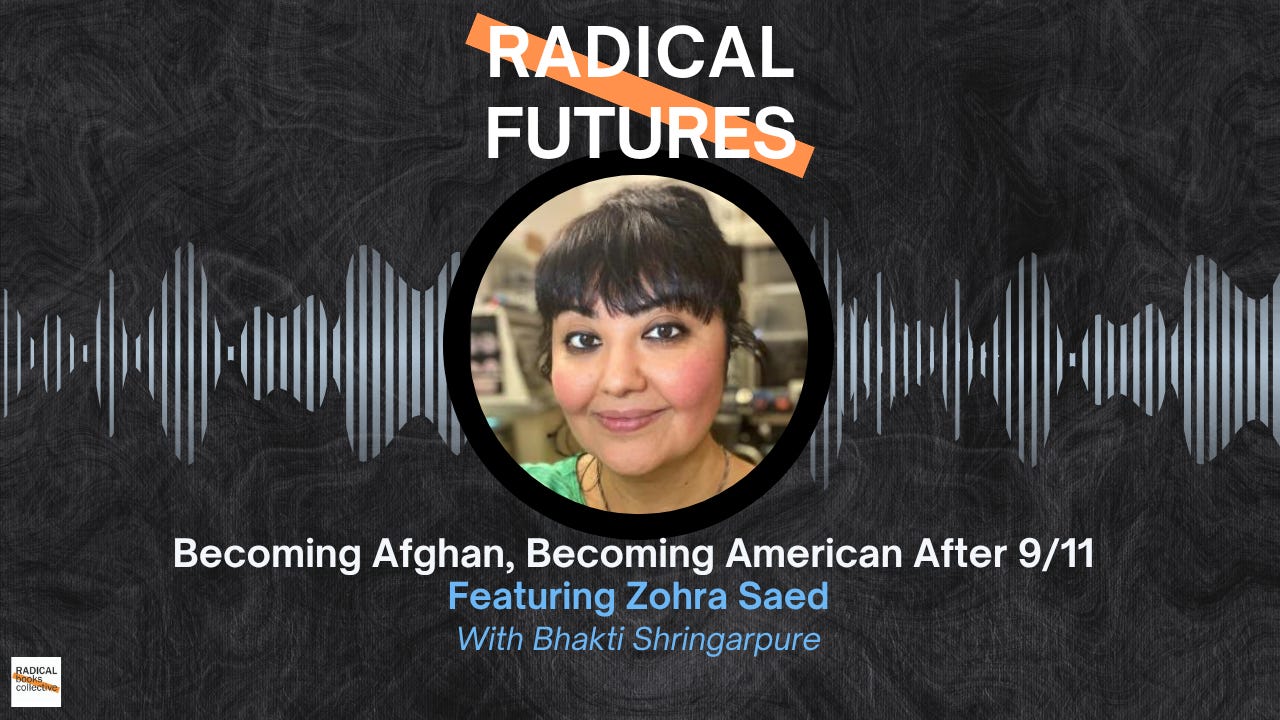
“You had to go and perform Afghan-ness,” scholar and poet Zohra Saed recalls as she speaks of the scary and difficult days soon after the towers fell in New York City. Afghanistan was suddenly in the spotlight as the location of 9/11 mastermind and head of Al Qaeda, Osama Bin Laden.
On the one hand, there were drums of war, boycotts of Afghan businesses, and violence towards Afghans in the US. But on the other hand, soft imperialism was in immediate motion as numerous cultural interventions began springing up. Afghan-American youth were being recruited by the US government for a suite of programs including language acquisition, visits to Afghanistan, starting a career as a journalist, or humanitarian work. All this was done under the guise of rescuing Afghan culture and saving Afghan women from the Taliban. There was a caveat: participants would often have to work alongside the American military. At the time, young people like herself were to become the “bridge generation” that would return to rebuild Afghanistan and bring democracy back. Instead, these returnees “became complicit in a lot of the corruption.” Zohra would come to refer to it as “a circus or like a masquerade of what Afghan-ness is.”
Even as Zohra found herself in these settings and got lucrative offers to be part of various American programs, she chose to become a keen observer of the phenomenon. and honed a sharp critique of US imperialism. Despite a resistance to perform her Afghan identity for the West, Zohra admits that these unfolding events and eventually, the US invasion of Afghanistan, was instrumental in shaping her trajectory as a thinker, poet, teacher and activist. She also became a tireless advocate for the victims of a horrific war and occupation that raged in Afghanistan right until 2021.
It is clear to Zohra that Afghanistan became a “bait and switch scam” where after two decades of promising democracy and freedom, Americans threw up their hands and resorted to hawkish Rudyard Kipling-like declarations that “Afghanistan can never be defeated.” And so, today, the Taliban carries on, stronger than ever, and empowered by foreign investments in what has been a horrific last five years.
In this intimate, powerful and honest conversation, Zohra recounts what was done and undone by 9/11 and by the War on Terror that blazed across the world for decades after, and ways in which these tragedies also led to building new worlds and new collectives. She is invigorated by working with archival material and remains committed to memory and heritage work focused on the Central Asia region through many exciting writing, editing, publishing and cooking projects.
Further reading:
Langston Hughes: Poems, Photos & Notebooks from Turkestan by Zohra Saed https://centerforthehumanities.org/product/langston-hughes-poems-photos-notebooks-from-turkestan/
One Story, Thirty Stories: An Anthology of Contemporary Afghan American Literature, edited by Zohra Saed and Sahar Muradi https://www.uapress.com/product/one-story-thirty-stories/
Decolonizing Afghanistan: Countering Imperial Knowledge and Power, edited by Wazhmah Osman and Robert D. Crews https://www.dukeupress.edu/decolonizing-afghanistan
UpSet Press https://upsetpress.org/
Hosted by Bhakti Shringarpure. Edited by Agatha Jamari.
Radical Futures is produced by Warscapes.
Title Music: “Cottonstorm” by Bayern Boom Beat
Subscribe | Follow www.radicalbookscollective.com


