


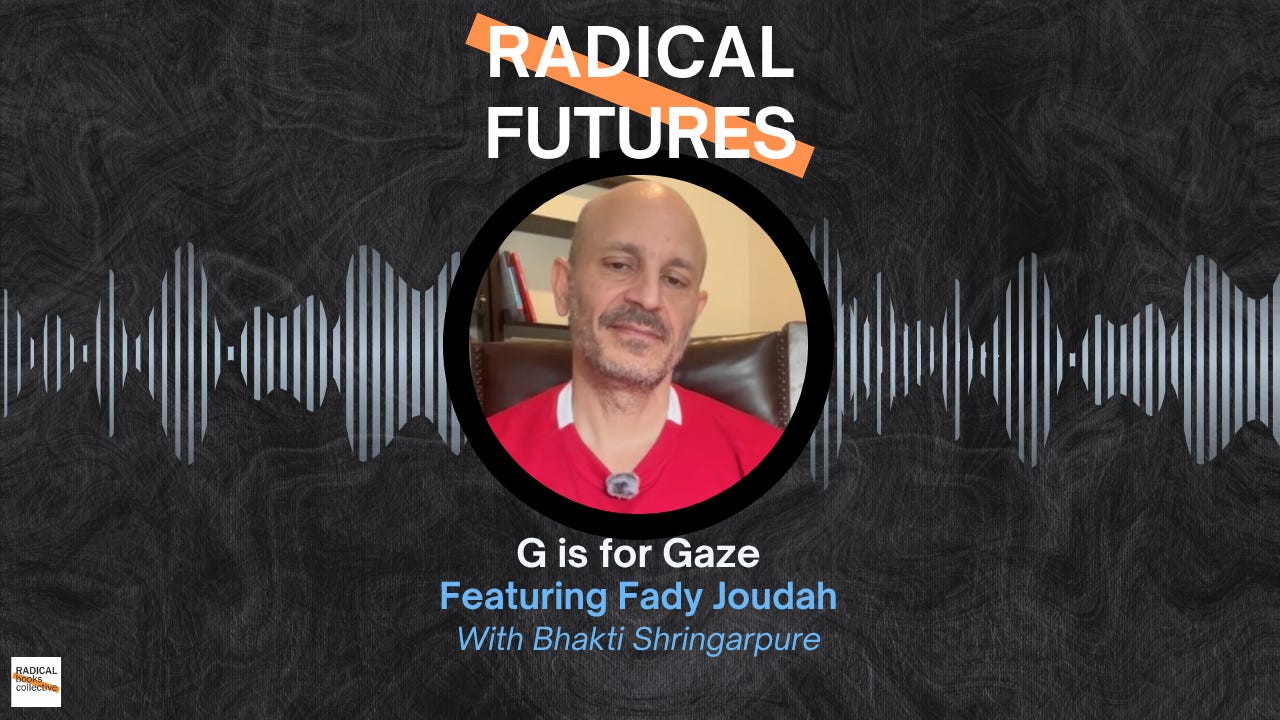
Fady Joudah’s seventh collection of poems is titled Exhibit G. After three years, G is now the most chilling letter in the alphabet. But before the mind races to G for Gaza or G for genocide, it is the word “exhibit” that stops you in your tracks. Never before in history has suffering been exhibited, presented, demonstrated, broadcast, documented, and paraded before us as it has been with Palestinians. The ridiculous “us,” the bystanders and the consumers, have willingly or unwillingly, become complicit in a shocking spectacle. We imagine that we are the ones who see but Joudah’s Exhibit G makes painstakingly clear that it is they, the Palestinians, who see us. The G will also be for guilt.
Exhibit G makes its readers squirm. It is a moving collection of poems, essays and photographs of Gaza, as the subtitle announces, but it is despairing because it disturbs. This is not only because of the power of the poems and essays but due to the cumulative effect of the photographs juxtaposed alongside the words. Joudah’s friendship with Hani Almadhoun who had started the Gaza Soup Kitchen in northern Gaza made him the recipient of an influx of photos and videos from 2024 onwards, a vast majority of them children. People received such things from Gaza “only as images or representations of horror” but Joudah “received them as a much wider world.”
They were “ordinary portraits” but he realized the profound gesture embedded in their ordinariness. “When they were filming or photographing other Palestinians coming to get water or food, it was because they were really keen and tender on capturing Palestinian beauty, color, life…and the love that shows in the adults or the parents who send kids to stand in line for water and food, and to dress them up a certain way.” This ordinary, wider world revealed itself in the puzzling sweetness of the details: “Why is one wearing a fake Prada shirt and the irony of it, or a Superman pajama, or barefoot or not. The kids are asked to pose for a victory sign…”
For Joudah, they unlocked a Palestinian interiority that spoke on its own terms. “I really let all this Palestinian-ness come into me.”
The poems that accompany--Joudah’s as well as a few by Rawan Hussien and Nima Hassan that he translates into English--weave through the archive of photos with startling intimacy. They complement and compound. They reflect on Palestinian interiority and the insufficiencies of the English language; on history, memory and mythology; and, on truth and time. The tender ordinariness of quotidian life during a genocide captured in the book creates a sinking feeling. But it is the gaze of the children that pierces. Sometimes they have big grins on their faces, sometimes tired smiles, sometimes a questioning glance, but their eyes always sparkle with life.
Exhibit G triumphs over all the savagery and abjecthood inflicted upon Palestinians by the sheer, life-giving force of Palestinians who make direct and unwavering eye contact with us. The G is for their gaze.
Buy the book here: https://milkweed.org/book/exhibit-g
Fady Joudah is the author of […], a finalist for the National Book Award and winner of the Lenore Marshall Poetry Prize. His other poetic works include The Earth in the Attic; Alight; Textu, Footnotes in the Order of Disappearance; and Tethered to Stars. He has translated several collections of poetry from the Arabic and is the co-editor and co-founder of the Etel Adnan Poetry Prize. He lives in Houston, with his wife and kids, where he practices internal medicine.
Hosted by Bhakti Shringarpure.
Edited by Agatha Jamari
Radical Futures is produced by Warscapes
Title Music: “Cottonstorm” by Bayern Boom Beat
Subscribe | Follow www.radicalbookscollective.com


