


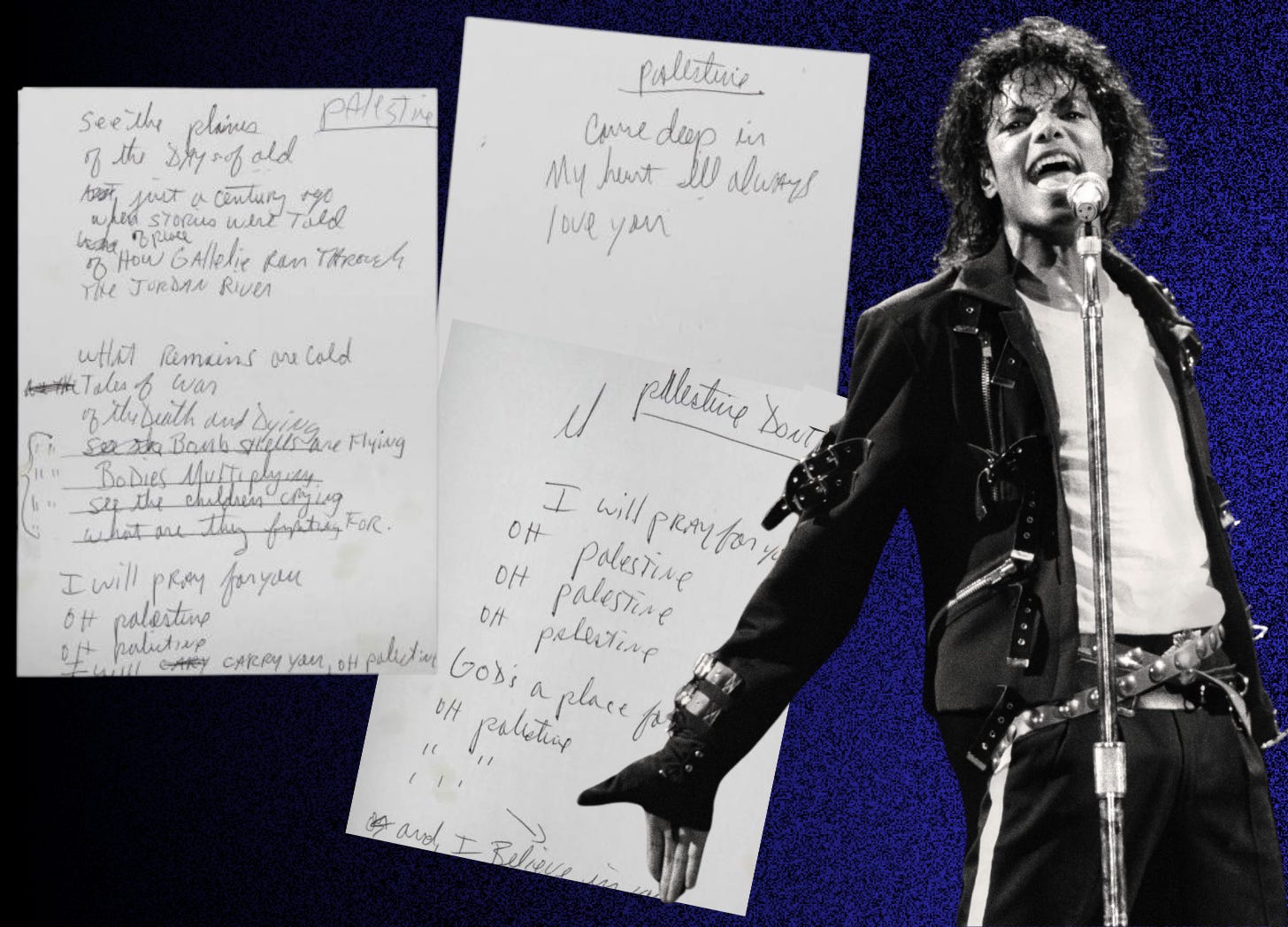
A few months ago, my Instagram feed lit up with a surprising piece of news about the late Michael Jackson. On his return flight from a 1993 concert in Tel Aviv, Jackson had written a song called “Palestine, Don’t Cry.”
I could not believe it. I needed to know if the lyrics were real. They are.
Somewhere mid-flight, high above the Mediterranean, Jackson took a sheet of British Airways Concorde stationery and began to write. He was coming off tour — exhausted, from a life he once described as “going through hell” on the road — and yet unable to turn away from what he had witnessed. On the page, in his own hand, appeared the lines: “Bomb shells are flying… see the children crying.” A plea drafted in transit, caught between departure and return, was preserved across two handwritten pages and later offered at auction. Whether a studio recording was ever attempted remains unknown. What exists, undeniably, is the paper trail.
I was shocked — not only that the song existed, but that it never entered the world as sound. If it was recorded, why was it never released? If it wasn’t, why not? I couldn’t help but imagine the impact: what it might have meant for those words to circulate beyond the cabin of that plane, to move as music rather than remain as a trace.
The search led me into a dense web of fan pages, TikToks, and threads that paired the lyrics with AI-generated versions of Jackson’s voice, completing what he never released. Within these spaces, fans attempt to account for the song’s disappearance by stitching together fragments of corporate history, media scandal, and organizational control.
What follows emerges from the accelerating flow of images from Palestine across digital platforms, converging with personal memory and archival research. How were Michael Jackson’s political positions policed, managed and mitigated when they became threatening, especially when it came to the Middle East?
We at the Radical Books Collective have been proud to engage with you, our community, through vital conversations in our book clubs, newsletters, podcasts and live events. We need your support so please consider becoming a paid subscriber.
Michael Jackson was a global storyteller whose songs, films, speeches, philanthropy, and spiritual reflections articulated a politics of love that included lament, outrage, and a call for justice. Yet his work — its circulation, suppression, and unexpected return — offers a case study in how solidarity is erased, repackaged, and, at times, recovered.
By returning to specific moments in Jackson’s dossier, including the unrecorded song “Palestine, Don’t Cry,” this essay examines how his politics were rendered dangerous, why they were sidelined, and what it means to encounter these moments again in a digital landscape that thrives on spectacle while disavowing responsibility.
What was erased were not vague humanitarian gestures, but solidarities that named violence and demanded accountability.
Jackson’s visibility was never neutral. For Black artists on a global stage, visibility serves less as protection than exposure — a condition in which recognition and risk intensify together. This paradox attracted some of the sharpest cultural critics of the twentieth century. James Baldwin, writing in 1985, saw in Jackson not a celebrity scandal but a mirror held up to America’s deepest anxieties about race, masculinity, and the guilt buried inside a nation built on violence. bell hooks, writing in the early nineties, argued that the systems consuming Jackson’s image were the same ones that disciplined what that image was allowed to mean. Both writers understood his visibility as a site of struggle, not performance.
As buzz around the forthcoming biopic Michael accelerates across social media, I find myself wondering whether it will do his politics justice. The film’s trailer reached 116.2 million views in its first hour, breaking Lionsgate’s record for the most-watched music biopic debut.
Around the same time, “Thriller” re-entered Billboard’s Hot 100, marking an unprecedented Top 10 presence across six decades. No celebrity has matched Jackson’s reach. His concerts spanned continents; his televised performances reached billions through broadcast television and radio long before the internet existed — the “Black or White” video premiered simultaneously in 27 countries to an estimated 500 million viewers in 1991.
But metrics measure circulation, not recognition. They cannot capture kinship, memory, or the ways Jackson’s voice functioned as something more than performance. This is not an organic resurrection; it was a return engineered through numbers: views, streams, downloads, earnings — indicators of presence that obscure power.
Jackson’s voice is everywhere again, but on terms he did not choose: algorithmic repetition stripped of context, celebration without accountability, profit without politics.
The magnitude of Jackson’s return is undeniable. Its meaning is not.
What does it signify that his voice returns not through official structures, but through memory and technology, at a moment when images of Palestinian children reappear endlessly, yet justice remains out of reach?
To understand what has been recovered and what has been erased, we must see him not simply as an icon revived, but as a history regulated by institutions.
Archive and Algorithm
I didn’t find a Michael Jackson archive in a library. His work reached me through online platforms — fragments surfacing without context, circulating without explanation. Official archives are not neutral repositories. They are places of selection, exclusion, and power, preserving what institutions need remembered and quietly setting aside the rest.
Jackson’s work travels differently — not as official history, but as an afterlife. Algorithms circulate it. Fans animate it. Power still frames it. But the logic of exclusion remains the same.
This understanding of archive — one that includes not only what survives and circulates but also what is deliberately ignored or silenced — shapes how I read Jackson’s legacy. It encompasses official records, fragments, memories, rumors, images, and the afterlives of works that resist complete erasure. In this context, Jackson emerges as a living repository: not simply because he produced a body of work, but because his life, performances, lyrics, controversies, and global influence make visible the stark difference between what is officially remembered and what is hidden.
The disappearance of “Palestine, Don’t Cry” is less a mystery to be solved than a pressure to be felt — a sense that certain commitments could not move freely once Jackson’s power exceeded the industry’s capacity to contain him. That pressure has a history.
After acquiring a 50 percent stake in the Sony/ATV catalog in 1985, Jackson became not only a performer but an economic force. The conflict surfaced publicly in July 2002, when he condemned Sony Music chief Tommy Mottola at Rev. Al Sharpton’s National Action Network, accusing the industry of exploiting Black artists. These remarks followed disputes over the Invincible album’s promotion and Sony’s refusal to release his charity single “What More Can I Give” after 9/11. Jackson’s politics did not disappear; they collided with infrastructure.
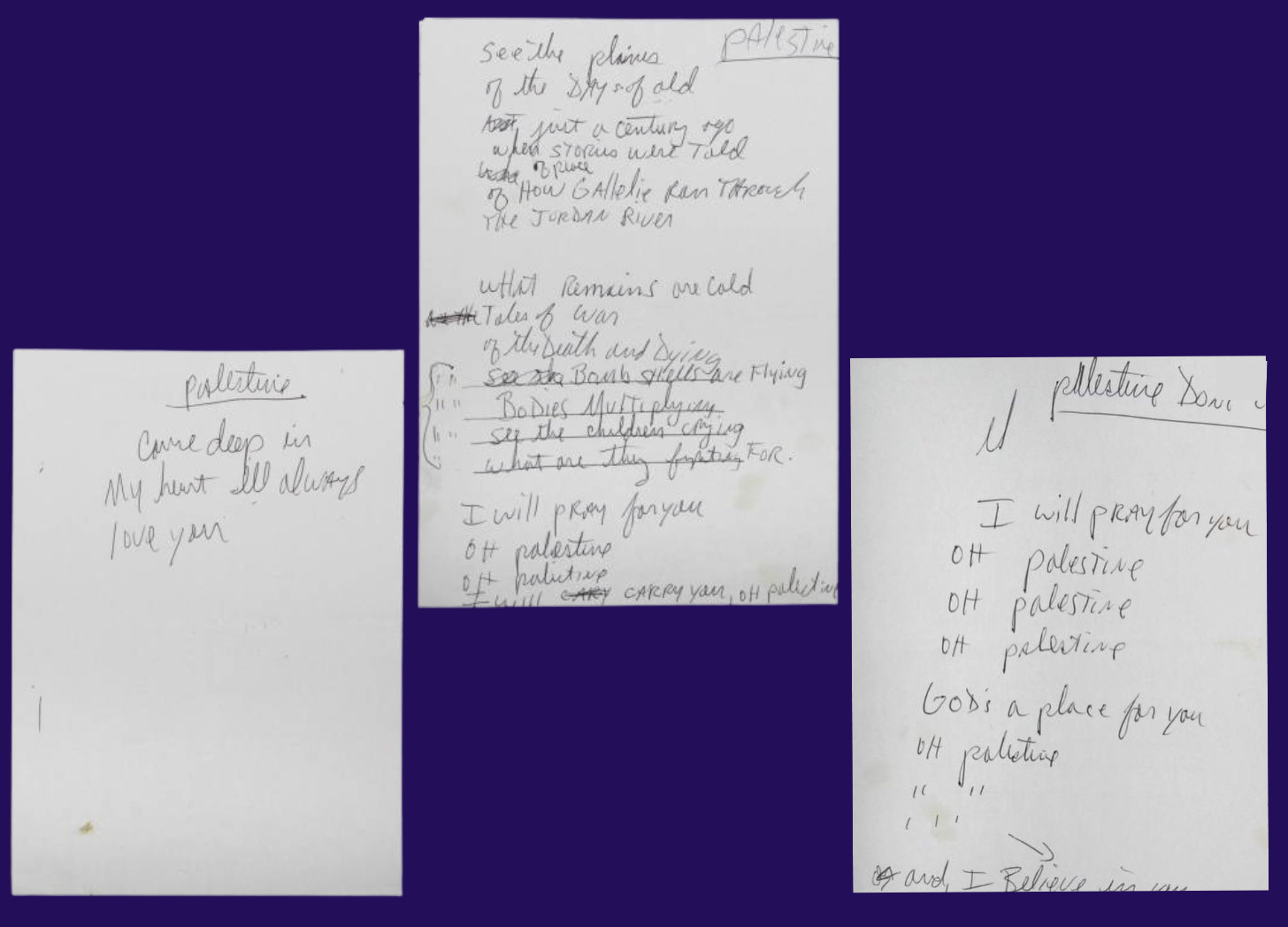
Yet what unsettled me wasn’t simply why “Palestine, Don’t Cry” didn’t circulate. It was why its absence felt personal — why this fragment, at this moment, collapsed the distance between record and memory. The relentless spread of images from Palestine — dead bodies, grieving parents, the cries of children — kept drawing me back to Jackson. When I saw the verified lyrics in his handwriting, something clicked in my chest. A song written in 1993 was resurfacing now, and it did not feel like a coincidence.
This isn’t equivalence. It is an ethic of recognition — one articulated through Jackson’s work — that centers children as moral witnesses, treats vulnerability as politically meaningful, and refuses to normalize violence, whether intimate or state-sanctioned. “Palestine, Don’t Cry” is not an anomaly. It is an inevitability.
History provides many examples of influential public figures whose impact unsettles the establishment. Some were silenced through violence; others managed through narrative. Jackson belongs to the latter group.
With the internet now extending his reach beyond anything he experienced in life, he could mobilize recognition, grief, and solidarity on a scale that made the establishment nervous. Rather than eliminate him, the media and industry shifted focus toward spectacle, controversy, and sales — moving attention away from the violence he named and the solidarities he built.
James Baldwin called out this dynamic in his 1985 essay “Here Be Dragons” (originally titled “Freaks and the American Ideal of Manhood,” first published in Playboy Magazine in January 1985). He argued that the noise around Jackson was not really about Jackson at all, but about America’s fear of what he revealed: the instability of masculinity, the commodification of Black life, and the guilt buried inside a nation built on racial violence. Baldwin did not treat Jackson as a scandal to be solved. He saw a figure who unsettled the very institutions that profited from him. The noise grew louder when Jackson could no longer be pushed aside or neatly explained. What followed was not recognition. It was discomfort. Then blame. Then erasure. Jackson forced a confrontation that few were willing to face.
Baldwin understood, as Ralph Ellison had before him, that visibility and recognition are not the same thing — Black life can remain on display and still go unseen, filtered through projection and control.
In the early nineties, feminist scholar bell hooks wrote that reducing Jackson to a figure of self-rejection distracted from the systems that shaped and disciplined his image. Those systems depend on Black presence while carefully managing what that presence is allowed to mean. In her reading, Jackson’s public persona cannot be separated from the forces that consumed and reshaped it. This was never neutral ground. It was a site of struggle.
What Baldwin saw domestically, he also traced globally. He openly supported Palestinian self-determination and described colonial violence as a global structure, not a local problem. Through his lens, Jackson’s solidarities — especially those that named state violence across borders — do not look naïve. They look threatening to systems built on denial.
Fragments of the Middle East
Palestine did not simply appear in Michael Jackson’s work. His attention to Palestine was not a detour from his worldview. It grew directly from it. His criticism of state violence and his sense of global moral responsibility fit within a way of thinking he had been developing for years through reading, reflection, and careful attention to how power shapes what we are allowed to see.
Calling these gestures impulsive and sentimental misses the point. Jackson knew exactly what he was doing — and the risks that came with speaking through sound, image, and movement in public space.
To distinguish speculation from verifiable history, I contacted Brad Sundberg, who worked closely with recording engineer Bruce Swedien and extensively with Jackson in the studio. Sundberg confirmed that, to his knowledge, “Palestine, Don’t Cry” was never recorded, and he has no recollection of Jackson discussing the song at the time. Importantly, he emphasized that Jackson “could record whatever he wanted — he had no restrictions, he was the Boss.”
This clarification does not resolve the mystery; it reframes it. The lyric remained on paper, never making its way through the conventional channels of production or release. What we possess is not an audible song but a visible testament — words etched on paper — that captures where its political significance endures. In this sense, the written lyric becomes an alternative archive, one that defies typical documentation: not merely an artifact of absence, but a political statement in itself.
What he left behind is extensive: speeches, interviews, handwritten lyrics, short films, concerts, and philanthropic work that make his commitments clear. The record does not look scattered because he had little to say. It looks scattered because others shaped what the public was allowed to see. Media outlets, record labels, and audiences invested in a simple, marketable story that filtered what could safely spread.
Observers have noted for years that his affinity with the region — and with Islam — was often downplayed because it complicated familiar narratives. During his mid-2000s legal crisis, news outlets reported that individuals associated with the Nation of Islam were present within Jackson’s security detail. Both sides denied any formal arrangement, but the reporting itself became part of how his connections to the Middle East and non-Western political traditions were publicly framed and debated. Taken together, this record shows something steady: a sustained moral attention to Palestinian suffering and to the Middle East as part of his ethical horizon. He paid attention. He wrote. He imagined otherwise.
That ethic was made visible in September 1993, during the Dangerous World Tour, when Jackson performed two concerts in Tel Aviv just days after the signing of the Oslo Accords between Israel and the Palestine Liberation Organization (PLO). The agreement was framed as a five-year interim process meant to lead to a permanent settlement by the end of the decade — a horizon of cautious optimism that would collapse by 2000 amid assassinations, stalled negotiations, and renewed violence.
Jackson never publicly commented on the accords, nor did he present his visit as a diplomatic endorsement. Yet contemporaneous reporting makes clear that the concerts were received — and deliberately framed — through Oslo’s political moment. Between shows, Jackson visited children in hospitals, dividing his time between Jewish and Arab patients. Organizers told reporters they were “hoping to get Israeli and Palestinian children” onto the Heal the World stage chorus, describing the timing as “very special” in light of the agreement — a plan widely discussed at the time, even as available records do not definitively confirm that such a joint appearance occurred.
A UPI account described visuals of “Palestinian children wrapped in their black-and-white keffiyehs…run past armed Israeli soldiers, then join in a multi-racial gathering of children singing to make the world ‘a better place.’” In a moment defined by diplomatic abstraction and unresolved structural violence, Jackson did not perform peace as policy. He staged recognition — placing Palestinian presence and children’s vulnerability in the foreground of a global humanitarian display. That recognition had its own limits on the ground.
During the same visit, Jackson attempted to approach the Western Wall but was physically blocked by ultra-Orthodox Jews; his managers argued without success. He moved on without the access he had planned. The moment was not widely reported. It fits the same pattern: presence was welcomed in the abstract, controlled in practice.
Even before Tel Aviv, that recognition had already met resistance. In the late 1980s and early 1990s, Saudi record stores reportedly refused to sell Jackson’s music in public. Rumors circulated that he had made anti-Arab statements, though no proof ever surfaced. In 1996, Jackson appeared on the Arab television network MBC to dispel them directly. A child asked him whether he “didn’t like Arabs.” Jackson answered without hesitation: “No, that’s not true at all. I love Arabs. I love all people of the world. This is an example of how people make up stories that aren’t true.” This was not a vague statement about unity. It responded to a specific moment, in a specific place, where exclusion had already taken hold.
That moment was followed by something more concrete. During the HIStory World Tour, Jackson planned two concerts in Casablanca that would have brought him further into the Arab world. He traveled to Morocco in advance, and anticipation grew among fans. The concerts were later cancelled, reportedly for security reasons. What remained were photographs of arrival without performance — a promise that never became an event. This was not simply a scheduling problem. It fits a pattern that appears throughout his career: he could circulate as an image, but when that presence moved toward something lived and physical, it often met resistance.
Instead, that presence manifested elsewhere. In October 1996, Jackson brought the HIStory World Tour to Tunis, Tunisia, performing at Stade Olympique El Menzah in front of tens of thousands of fans — his first and only concert in an Arabic-speaking country. If Casablanca represented a paused encounter, documentation of silence, Tunis became a record of reception.
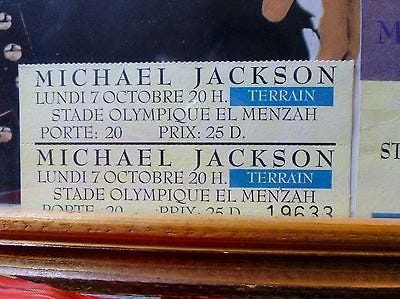
For many Tunisians, the event was not just a pop performance but a cultural milestone. Fans who attended still remember it decades later — the crowd’s energy, the sense of shared pride, the feeling that the world had briefly come to their city. Some saved ticket stubs as keepsakes; others called the night “magic,” not because of celebrity proximity, but because of the shared moment of presence: joy, belonging, and recognition that circulated entirely outside Western media and official narratives.
But not all forms of presence require an audience.
In 2005, soon after after Jackson was acquitted on all charges of sexual abuse he sought refuge in the Middle East, living for extended periods in Bahrain and later Dubai while withdrawing from U.S. media scrutiny. Rather than a disappearance, this marked a reorientation — away from spectacle and toward privacy, relational ethics, and continued creative work. Stories from those who encountered him during this period describe a man exhausted by exposure yet deeply engaged: composing music at dinner tables, organizing humanitarian responses to Hurricane Katrina, and moving through public space without the aggressive surveillance that had defined his life in the West.
Bahrain became a counter-archive — one largely absent from dominant music histories — not because nothing happened there, but because what occurred resisted commodification. In a cultural context that discouraged paparazzi and possession, Jackson was received rather than consumed.
When placed beside the handwritten lyrics of “Palestine, Don’t Cry,” the cancelled Casablanca concerts, the televised reassurance, and the years in the Gulf, the pattern is clear. The record is not fragmented. The through line is steady: solidarity at the core of his worldview, and Palestine was part of it — even when the institutions around him worked hard to ensure that full recognition would never quite arrive.
When Solidarity Becomes Dangerous
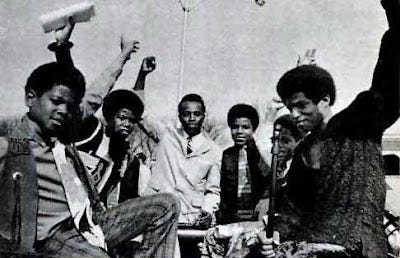
Jackson understood the limits placed on his visibility early. He once recalled that even when they were a Motown act, handlers stepped in to keep politics out of interviews. When a reporter asked the Jackson 5 about Black Power, a representative interrupted to say the group was “a commercial product” with no political concerns. Jackson remembered that as they walked away, he and his brothers “winked and gave the power salute.” Political awareness was present but carefully controlled — expression was allowed only indirectly. The lesson was clear: visibility was permitted, but legibility was policed.
That paradox — being seen everywhere but understood narrowly — followed him throughout his career. The same global visibility that enabled Jackson to show solidarity also made those gestures legible to institutions focused on controlling them. Praxis does not neutralize power; it exposes it.
What remains in the record is not perfect consistency but fragmentation: some commitments emphasized, others downplayed; some gestures celebrated, others quietly removed. The contradictions we observe are not failures in his thinking. They illustrate the limits placed on what he was allowed to do publicly. Hope was acceptable. Naming violence was not.
“They Don’t Care About Us” (1996) marks the moment when that containment faltered in plain sight. The song was neither a personal grievance nor an abstract plea; it was a global protest anthem that named racism, state violence, and abandonment as structural conditions. Jackson reinforced this message by creating two separate short films with Spike Lee: one filmed in a Brazilian favela, the other set inside a U.S. prison. Together, they depicted injustice as both transnational and systemic, connecting incarceration, poverty, and racialized governance across borders.
The song’s reception was quickly redirected. Public attention focused on its use of anti-Jewish slurs, prompting Jackson to apologize and alter the lyrics. He did not do so quietly. By multiple accounts, he pushed back hard — arguing, resisting, fighting for control over the song’s meaning before ultimately making the change. He conceded linguistically but the core indictment of racism and state violence remained intact. The goal of those demanding the edits was not to improve the song but to shift attention — moving it from the systemic violence the song describes to the policing of language and intent. As Lee later noted, similar scrutiny was rarely applied when racialized language circulated without consequences elsewhere.
That logic of containment reappeared during the filming of the Brazil video. Rio officials objected to the shoot, arguing that showing a favela could damage the city’s international reputation, and legal measures were taken to stop the production. When official support failed, movement was arranged through other means. Lee later explained that because Brazilian police refused to enter the favela’s hills, the production secured safety through negotiations with local power structures understood to control the area. This is unsettling not because it romanticizes criminal authority, but because it reveals how fragile state control can be in areas long neglected by formal government.
When the state couldn’t manage the image Jackson aimed to create, authority was rerouted rather than resolved.
This pattern recurs throughout Jackson’s work. His philanthropy was celebrated, then administratively constrained. His economic independence was accepted, then contested. His mass addresses were welcomed — until they named power. The issue was never tone; it was scope. The establishment resisted the idea of a Black global figure mobilizing grief, recognition, and care on his own terms. These moments do not reveal inconsistency in Jackson’s ethics; they show how quickly solidarity becomes threatening when it reaches millions.
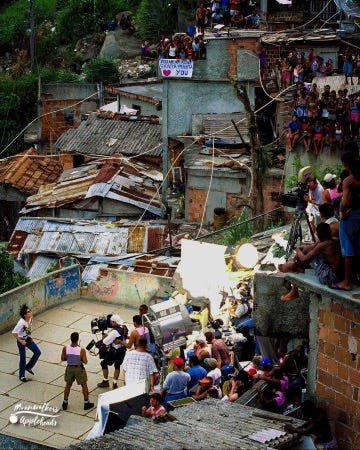
The orchestrated diversion did not last. “They Don’t Care About Us” remains materially embedded in places like Rio de Janeiro, where the statue from the video still stands — not as nostalgia, but as testimony. Institutions tried to suppress the song. People kept singing it. Jackson’s ethic endured through forms of distribution that stripped it of context while preserving its force — moving through people rather than remaining confined within bureaucratic structures. This is what a living repository does.
The song has since been adopted as a protest anthem wherever state violence meets organized refusal. During Black Lives Matter protests in the mid-2010s and after George Floyd’s death in 2020, crowds rallied around its chorus as a call against police brutality and institutional apathy — a theme underscored by Spike Lee’s 2020 music video weaving historical footage with contemporary demonstrations. In 2025, demonstrators sang it outside the federal detention facility in Broadview, Illinois, during an anti-ICE protest — a pointed critique of systemic indifference to state violence and detention.
But nowhere has the song’s reactivation been more striking than in Palestine. On social media, videos circulate of children dancing and singing along — not as passive nostalgia, but as a physical response to a world that has persistently refused to see them.
In these performances, Jackson’s voice becomes something more than a commercial artifact; it becomes a historical trace that children use to assert their presence, resilience, and refusal. That a song written about Black American suffering could travel so far and mean so much is not a coincidence. It is evidence that cultural artifacts do not have fixed meanings — and that the most marginalized often know best how to activate them. Each time someone sings “They Don’t Care About Us” in protest, shares an image, remembers a lyric, or asks what was left out of the story, the history expands again. What the formal record could not suppress, people continue to keep alive — not as passive custodians of his legacy, but as practitioners of the same ethic he modeled. He always found another way through. So have they.
Radical Love
For Jackson, love was never private or symbolic. It was a public practice, expressed to millions through tours, performances, and philanthropy — and precisely because of that reach, it was never allowed to exist in a neutral environment. The institutions that celebrated his sentiments grew uneasy when those sentiments began to name specific violence and demand specific accountability.
Jackson viewed radical love as a duty, not just a feeling. “In a world filled with hate, we must still dare to hope,” he told the Oxford Union in 2001 — a line often dismissed as naïve. But love, in his view, required intentional effort, repetition, and perseverance. His choruses were more than emotional pleas; they were calls to action, repeated until they could not be ignored.
“Heal the World” (1992) shows how Jackson transformed feeling into responsibility. Often dismissed as sentimental, the song functioned as a directive in his hands. The Heal the World Foundation extended that ethic into hospital visits, disaster relief, and child-focused aid — bridging the distance between performance and action. Music did not merely speak about care; it organized it.
“Earth Song” (1995), originally titled “What About Us,” pushed further. It named environmental destruction, war, animal suffering, and children’s pain at a scale that matched the violence it described. In rehearsal footage later shown in This Is It, Jackson envisioned a bulldozer heading toward the stage as he sang. In the official video, time reverses as collective witness halts the destruction. He was not being abstract. He repeatedly showed people exactly what he wanted them to see — theory rendered choreographically, an argument made visible and repeated until recognition became unavoidable.
When American radio resisted the song, calling it too heavy for domestic airplay and giving it minimal promotion, he did not reshape it for U.S. tastes. Instead, he let other publics amplify it. “Earth Song” became one of the best-selling singles in UK history and a massive hit across Europe — evidence of what became a recurring strategy: when one market closed, he found another, and the message traveled intact.
That language of care did not appear by accident, and it traveled far beyond Western media circuits. In the Middle East especially, listeners heard his music not simply as entertainment but as a moral address — resonating with themes of healing, dignity, and responsibility that crossed national and religious boundaries. His music endured not because it was neutral, but because it spoke in a register that people recognized across vastly different circumstances. That reach was not accidental. It was built.
By many accounts, Jackson kept a personal library of nearly 10,000 books and read constantly across psychology, philosophy, religion, and political thought. Family members, friends, and collaborators recalled long conversations about Freud, Jung, ethics, and spirituality. Reading was integrated into his training the same way movement and sound were — used to sharpen the moral and intellectual framework behind everything he put on stage.
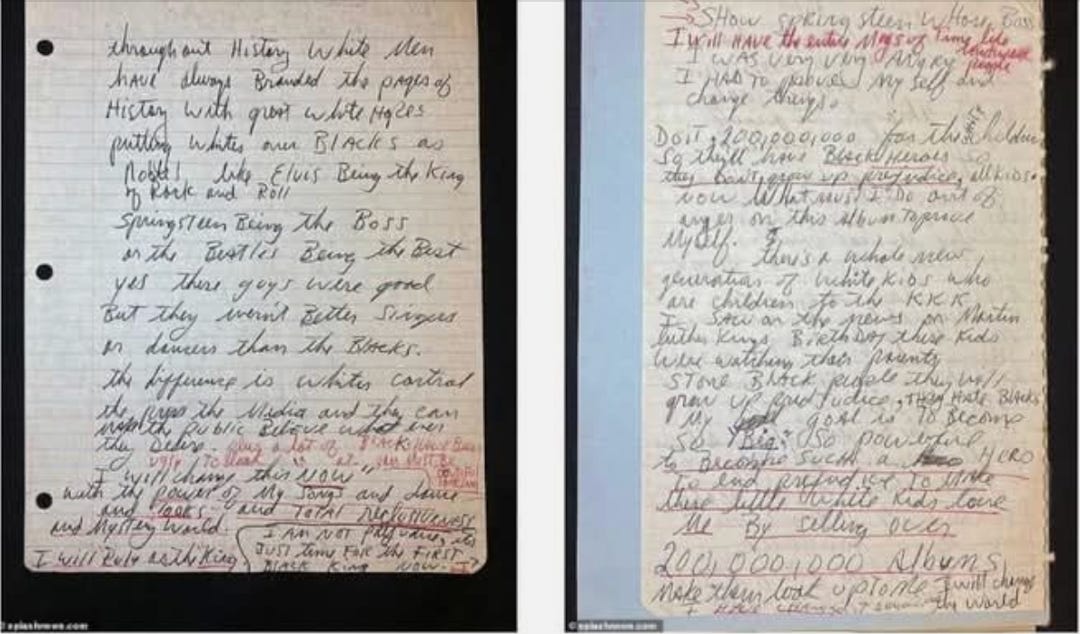
You can see this in his private notes from the 1980s, written long before the controversies that later consumed his public image. In them, he reflects on racial hierarchy in music, media control, and the pressure placed on Black artists to outperform just to be recognized. He framed ambition as responsibility. He returned repeatedly to the idea that prejudice must be confronted before it can be passed down. These notes reveal a person thinking carefully about power, presentation, and love as forms of work.
One of the last lines he left for himself reads: “Love, no violence ever. Remember a beautiful future. Promise of tomorrow.” He wrote this without an audience. It sounds less like a confession and more like an instruction. If his public work asked the world to heal itself, these private reminders show how he tried to hold himself to that standard first. Once that ethic moved from private discipline to global address, it ceased to appear as sentiment. It began to resemble intervention.
The Promise of Tomorrow
My biological father kidnapped me for a day when I was six years old. My parents had separated, and my dad would follow me in his car as I walked to school, without my noticing. One day, some boys were teasing me, and he shouted at them and told me to get in the car. I happily slid into the back seat of his 1965 Bonneville, and just as I rested my head and closed my eyes, the radio crackled, and Michael Jackson’s voice filled the air, smooth and steady: “…where there is love, I’ll be there.” It was a foundational experience — being rescued by my father and Michael Jackson — that shaped my ability to cope with precarious environments throughout my life.
Soon after, my parents divorced. I waited for my father to return, but he never did. Instead, Michael Jackson’s voice became a way to self-soothe. I would play Jackson’s lyrics in my head: “I’ll reach out my hand to you, I’ll have faith in all you do, just call my name, and I’ll be there.”
Fifty years later, I hear Michael Jackson singing “You Are Not Alone” in my head, unprompted. At first, it felt random. Now I notice it most when I wake and when I fall asleep. These are the hardest days of my life as I come to terms with losing my job and all the betrayal that accompanied it. Jackson’s voice rises from the depths of childhood memory, keeping me from falling into the abyss.
I absorb violence daily in overlapping layers. I am surrounded by the relentless political rhetoric that frames state violence as a solution rather than harm, and the constant stream of images and reports of civilian deaths — abroad and at home — caused by state actors. This mosaic of intimate and geopolitical violence saturates daily life and complicates any possibility of care. The world remains, as Jackson wrote in his 1992 poem, one of “alienation, fragmentation, abomination… this cruelty, hysteria, absolute madness.” If he were alive, I believe he would be horrified to see how little has changed. In many ways, it is worse.
I still hear him at the edges of sleep. Not the Michael Jackson of algorithms and anniversaries, but the one who wrote on Concorde stationery somewhere above the Mediterranean, who visited children on both sides of a war, who built a library of ten thousand books and tried to think his way toward something better than the world he inherited. That Jackson — the one who named violence, who staged recognition, who understood solidarity as a discipline rather than a sentiment — was not lost to time.
He was managed. The archive was not abandoned; it was curated selectively by institutions that knew precisely what they were setting aside and why. What returns to us now, in feeds and streams and AI-generated echoes of his voice, is the version they could profit from without being challenged. But the other version keeps surfacing — in the hands of children in Palestine singing words he wrote before they were born, in protesters outside detention centers, in anyone who has ever felt, as I did at six years old in the back of a Bonneville, that a voice reaching through the radio was also reaching through time, refusing to let the worst of the world be the last word.
His voice returns in moments of crisis not as comfort. It returns as an indictment of the silence that was engineered, of the solidarity that was buried — and of the wager that we would not notice what was taken from us.

Citations by section
OPENING / ARCHIVE AND ALGORITHM
“Palestine, Don’t Cry” — handwritten lyrics on British Airways Concorde stationery: Julien’s Auctions (2010). Michael Jackson Handwritten Lyrics — “Palestine.” https://www.juliensauctions.com/en/items/45115/michael-jackson-handwritten-lyrics
Michael Jackson’s acquisition of the ATV catalog in 1985: Billboard Staff (2016, March 16). “A Timeline of Michael Jackson’s Best Bet: The Sony/ATV Catalog.” Billboard. https://www.billboard.com/music/music-news/timeline-michael-jacksons-best-bet-sony-atv-7262944/
July 2002 Mottola speech at National Action Network / Sony refusing “What More Can I Give” : Associated Press (2002, July 8). “Michael Jackson Brands Recording Industry as Racist.” Billboard. https://www.billboard.com/music/music-news/michael-jackson-brands-recording-industry-as-racist-75178/
“Black or White” premiered simultaneously in 27 countries, 500 million viewers, 1991: Guinness World Records: https://www.guinnessworldrecords.com/world-records/114931-largest-tv-audience-for-a-music-video-premiere
Michael Jackson Official Site: https://www.michaeljackson.com/news/michael-jacksons-black-or-white-has-largest-short-film-premiere-in-history/
Thriller re-entering Billboard Hot 100 Top 10, first artist with Top 10 hits in six decades: Billboard (2025, November 11): https://www.billboard.com/music/chart-beat/michael-jackson-first-artist-hot-100-top-10-six-decades-1236109989/
Michael biopic trailer — 116.2 million views in first hour, Lionsgate record: TheGrio (2025, November 11): https://thegrio.com/2025/11/11/michael-jackson-makes-chart-history-again-as-thriller-returns-to-billboards-top-10/
James Baldwin, “Freaks and the American Ideal of Manhood.” Playboy. Reprinted as “Here Be Dragons” in The Price of the Ticket: Collected Nonfiction, 1948–1985. St. Martin’s Press, 1985. (pp. 677–690)
bell hooks Black Looks: Race and Representation. Boston: South End Press (1992).
FRAGMENTS OF THE MIDDLE EAST
Brad Sundberg: Personal communication with Sherry Zane, November 30, 2025.
Michael Jackson in Tel Aviv: “Michael Jackson makes it the Holy Land,” UPI (1993, September 17) https://www.upi.com/Archives/1993/09/17/Michael-Jackson-makes-it-the-the-Holy-Land/3822748238400/
Jackson blocked from the Western Wall by ultra-Orthodox Jews: UPI (1993, September 18). “Michael Jackson Stopped from Nearing Western Wall.” UPI Archives.https://www.upi.com/Archives/1993/09/18/Michael-Jackson-stopped-from-nearing-Western-Wall/4143748324800/
Saudi record stores refusing to sell Jackson’s music in public / 1996 MBC television appearance: Abbas, Faisal J. (2009, June 29). “Michael Jackson: The Man Who Rocked the Desert.” HuffPost. https://www.huffpost.com/entry/michael-jackson-the-man-w_b_221621
MJ Interview on Arab TV MBC: MJOuttakes. “Michael Jackson - Interview with Arabic | TV Channel MBC | 1996.” YouTube.
HIStory World Tour Casablanca concerts cancelled: https://en.wikipedia.org/wiki/HIStory_World_Tour
Tunis concert at Stade Olympique El Menzah, October 1996: Also documented on the HIStory World Tour Wikipedia page above. Several recollections also exist in fan accounts.
Jackson in Bahrain and Dubai after 2005 acquittal / oral histories: Taraborrelli, J. Randy (2009). Michael Jackson: The Magic, the Madness, the Whole Story, 1958–2009. Grand Central Publishing.
Cascio, Frank (2011). My Friend Michael. William Morrow.
WHEN SOLIDARITY BECOMES DANGEROUS
Jackson recalling Jackson 5 handlers blocking political questions / “commercial product” anecdote: Jackson, Michael. Moonwalk. Doubleday, 1988. Penguin Books (UK), 2009, p. 88. Jackson recounts a Motown representative telling a reporter that the Jackson 5 were “a commercial product” with no political concerns when asked about Black Power — and that he and his brothers “winked and gave the power salute” as they walked away. Note: the “commercial product” line is the representative’s answer, not Jackson’s own words. The essay has been updated to reflect this distinction.
“They Don’t Care About Us” — Spike Lee, two videos (Brazil favela and U.S. prison): Wikipedia, “They Don’t Care About Us”: https://en.wikipedia.org/wiki/They_Don%27t_Care_About_Us
Spike Lee’s account: Hyden, Steven (2025, September 8). “Spike Lee Nearly Passed on Working with Michael Jackson.” Parade. https://parade.com/celebrities/iconic-filmmaker-spike-lee-nearly-passed-on-working-with-michael-jackson
Rio officials legally attempting to stop the Brazil video shoot: Reuters (1996, February). Archive footage and wire report: https://reuters.screenocean.com/record/385197
Also documented in: https://deadspin.com/i-found-michael-jackson-in-a-brazilian-favela-1586673299/
Statue from the “They Don’t Care About Us” video still standing in Rio: Deadspin (2014), first-person account of visiting the statue: https://deadspin.com/i-found-michael-jackson-in-a-brazilian-favela-1586673299/
Spike Lee’s 2020 music video incorporating BLM protest footage: Hiatt, Brian (2020, August 29). “Spike Lee Updates Michael Jackson’s ‘They Don’t Care About Us’ Video with Protest Footage.” Rolling Stone. https://www.rollingstone.com/music/music-news/spike-lee-michael-jacksons-they-care-about-us-2020-video-1052190/
“They Don’t Care About Us” sung at Broadview, Illinois ICE detention protest, 2025: https://www.mjvibe.com/michael-jacksons-they-dont-care-about-us-rings-out-during-broadview-ice-protest/
RADICAL LOVE
Jackson’s Oxford Union speech, March 2001 — “In a world filled with hate, we must still dare to hope”: Jackson, Michael (2001, March 6). “Heal the Kids” speech, Oxford Union, Oxford University. Full transcript: https://southerncrossreview.org/66/jackson-oxford.htm
Jackson’s 1992 poem — “alienation, fragmentation, abomination… this cruelty, hysteria, absolute madness”: Jackson, Michael (1992). “Ecstasy.” In Dancing the Dream: Poems and Reflections. Doubleday.
“Earth Song” originally titled “What About Us”: Wikipedia confirms the original working title: https://en.wikipedia.org/wiki/Earth_Song
“Earth Song” — This Is It rehearsal footage / bulldozer: Michael Jackson’s This Is It (2009). Directed by Kenny Ortega. Sony Pictures.
American radio resisting “Earth Song” / not released as US single: Vita.it (2023, August 6): https://www.vita.it/earth-song-michael-jacksons-failed-call-to-environmentalism/
“Earth Song” one of best-selling singles in UK history / Christmas number one 1995: Official Charts Company: https://www.officialcharts.com/songs/michael-jackson-earth-song/
Jackson’s library of nearly 10,000 books: Martinez, Willy. (2021, September 7). “How Reading Helped Michael Jackson Become a Music Legend.” Mind on Fire Books. https://mindonfirebooks.com/2021/09/07/michael-jackson-reading-made-him-famous/
Jackson’s private notes from the 1980s — reflections on racial hierarchy in music: True Michael Jackson (2021). “Origin of the Title King of Pop.” Includes images of Jackson’s 1987 handwritten notes and affirmations to himself about racial inequality in the music industry. https://www.truemichaeljackson.com/art/king-of-pop/
“Love, no violence ever. Remember a beautiful future. Promise of tomorrow.” — the final private note: Medindia News Desk (2009, September 15). “Jackson’s ‘String of Messages’ in His Final Hours Have Come to Light.” Medindia. https://www.medindia.net/news/jacksons-string-of-messages-in-his-final-hours-have-come-to-light-58026-1.htm
Daily Express (2019) — article with images of the notes: https://www.express.co.uk/news/world/1145027/michael-jackson-death-notes-discovered-room-lyrics-thoughts-spt

I love the depth of your writing and how much effort (and heart) you've clearly put into this. I've always loved Michael's music and his commitment to use his massive platform for social causes, so when I knew of his awareness of Palestine, I needed to search further about it and I'm happy to have stumbled upon your article. Thank you!
This made me cry!! Thank you for writing it Sherry. It’s important to have people like MJ in this world, and it’s more important to BE like MJ. We have to care about each other, we’re all we have.