


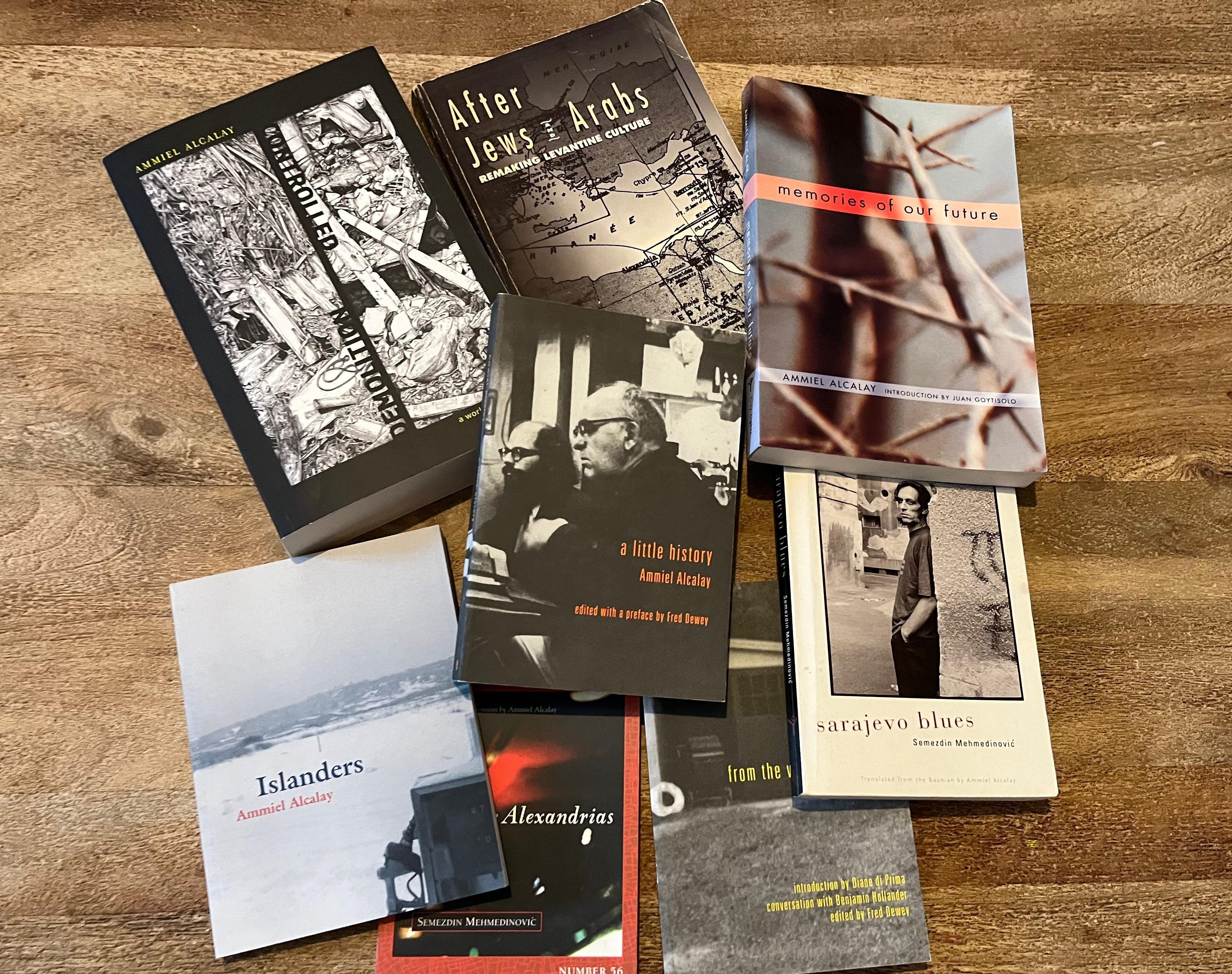
In more than two dozen books spanning Iraq, Bosnia, Palestine and Vietnam, poet, translator and scholar Ammiel Alcalay has crystallized a piercing critique of American imperialism. He illustrates a commitment to places and people upon whom the bloody trail left by American excursions is inscribed, whether abroad or at home. He has crafted a unique insider-outsider approach grounded in poetic practice, a study of languages, and that embraces a wide range of materials: news, poems, letters, books, essays, reports, speeches, music, art, comics, radio, conversations, and more. His work goes against the grain of institutionalized forms of writing and allows for an excavation of political, historical and literary narratives that have been deliberately buried, obfuscated and redirected.
The most recent illustration of Alcalay’s prowess is Controlled Demolition: a work in four books, a formidable volume that attempts a delicate trapeze act between poet, historian, librarian, teacher and journalist. Quotations from firefighters breathe alongside lines from Virgil, incarcerated Palestinians, Vietnam War veterans, and egregious formulations from reports and hearings. The book is anchored in the events of 9/11, and all that before and after. Alcalay’s strategic use of poetic collage ruptures officially received narratives (essentially state propaganda) that proliferate the mainstream about the world we live in and also expose America’s role in shaping it.

Our conversation was wide-ranging, yet focused on historicizing and contextualizing the present moment as genocide continues in Palestine, as American universities unravel with shocking speed, and as the grip of authoritarianism and fascism tightens worldwide. When it comes to Palestine, Alcalay reflects on past events that have created the material conditions for the genocide to take place with full global complicity, all in the bright light of day. From 2018 onwards, he says, the world has been in a state of immense tumult, with demonstrations in Lebanon, Chile, Columbia, Hong Kong playing out alongside the Hirak protests in Algeria and the Great March of Return in Gaza.
“Suddenly, boom, coronavirus - everything shuts down,” Alcalay says. “Enormous freedom of movement curtailed.”
He adds that Gaza was very much on his mind as he realized that these social movements and their ensuing suppression would create resounding and long-lasting reverberations that would likely become compounded in Gaza.
He was right. It is clear, as he says: “We’re all heading to Gaza. That’s the model for the world.”
The “Gaza model” evokes what Aime Césaire called the “imperial boomerang” whereby empire’s violence abroad inescapably boomerangs its way back home. Examples abound as terrorizing ICE agents roam the streets in the US and brutal practices of incarceration in North America, Europe and Asia mimic Israel to a fault.
For Alcalay, however, one has to go even further back to understand the “Gaza model.”
“The war in Iraq is a gaping hole in US behavior, thought, culture, politics, etc. It’s like a blast crater, and so many of the things that have been happening in Gaza -- withholding of food -- all of that happened in Iraq, was done by the US, and they killed hundreds of thousands. And the general culture has no clue whatsoever about any of that.”
To a large degree, American wars in the Gulf, and the amount of violence inflicted on Iraq through sanctions and “shock and awe,” have rarely penetrated the public psyche. Interventions in the Gulf intensified soon after the devastating American wars in Vietnam and Southeast Asia. The mandatory draft had set the country ablaze and protests were pervasive. “The rebellions of the soldiers are not a small thing. They were momentous. The army could not be relied upon at a certain point because people were killing their commanding officers.” Those in power understood that governing such a population would require a change in direction, and the years from the seventies to the nineties are marked by covert wars and experiments in violence in Iraq. These same measures have now been replicated at home: “It’s dealing with the US population as a counterinsurgency operation.” The CIA adage that “the real war is over the mind” was adapted across the board.
Gaza has shocked the world, Alcalay explains, not only because these forms of brutalization have been obscured from the public, but also because of the horrifying speed and quantity with which they are being deployed. And simultaneously, the culture of protests has also changed over the years. The protests trying to stop the American invasions of Iraq and Afghanistan after 9/11 lacked the immediacy and collectivity that was present during the war in Vietnam, proving that modes of control and surveillance have successfully proliferated. The vicious and swift suppression of pro-Palestinian protests in the last two years is proof.
A key vantage point for Alcalay has been the American university; he has been teaching at the City University of New York for several years, and was one of first academics to be doxxed after 9/11. He has a cynical view of American academia and is not surprised at how low American universities have sunk when it comes to the mistreatment of their own students and faculty. The history of the Cold War is littered with stories of scholars who were spies and researchers in cahoots with the government. But now, “the whole structure is part of it,” Alcalay says. “The wealth transfer that has occurred in the last 50 years is unfathomable.”
There is no longer a selective influence of donors on the university system, but rather, it has become the norm and everything is dictated by corporate interests, he adds.
“The progressive incorporation into a military technological model that exists now has moved apace in the last 50 or 60 years.” Alcalay offers a comparison between the university system as it existed in Gaza and selective universities in the US.
“What emerged from Gaza universities were doctors, engineers, poets, artists, extraordinary designers - in many ways a skill-based foundation with enormous energy, creativity and desire to do something collectively important for people.” Meanwhile, in the US, there is a secondary education where “people progressively learn less,” and since it is an “isolationist mode of learning,” there is no training in languages, geography or mathematics. By the time one gets to university, the college degree is barely sufficient, so there is “an economic prolongation of the educational system” sustained by dependency on loans. “The whole thing is skewed.”
Despite these sombre assessments, Alcalay continues writing, translating and teaching. He has been buoyed by the success of Palestinian poet Mosab Abu Toha, since Alcalay was instrumental in bringing him to an American audience. In particular, he has been furiously translating and collaborating creatively with writers in Gaza.
“This is a big year for books,” Alcalay says. He co-translated Nasser Rabah’s poems, and the volume Gaza: The Poem Said Its Piece was published by City Lights books this year. He is awaiting the publication of writing by Alaa Radwan, a student of the late Refaat Alareer, and is also working on a collaborative book titled Imperial Abhorrences with Gazan artist Kholoud Hammad.
Recalling that Alcalay spent many years in Jerusalem, is fluent in Hebrew, and has written a foundational scholarly work titled After Jews and Arabs: Remaking Levantine Culture, I ask him if he’s currently reading Israeli material, and if he can give us any insights into Israeli society and possible changes afoot. His response is a poem from Imperial Abhorrences.
turn the page
like hi-tech termites you’ve
eaten almost everything:
we know what you’ve
stolen lately but now
it’s entirely up to you to
prove what wasn’t stolen
long ago, from so-called
“time immemorial”: even
though it’s been ages since
I abandoned your alphabet
in witnessing myself I made
a most solemn vow to all
my departed companions
never to use it again un-
less it be to extirpate &
prosecute this radical
evil we’ve been
witness to,
on behalf of
beloved
Palestine.
Listen or watch below at the link below, and please support the fundraiser for Gazan artist Kholoud Hammad.
Love and solidarity❤️🔥
Bhakti Shringarpure
19. Poetry, Protest and Palestine: Featuring Ammiel Alcalay

In more than two dozen books spanning Iraq, Bosnia, Palestine and Vietnam, poet, translator and scholar Ammiel Alcalay has crystallized a piercing critique of American imperialism. He illustrates a commitment to places and people upon whom the bloody trail left by American excursions is inscribed, whether abroad or at home.
Previous publications
Omer Al Tijani on documenting Sudanese cuisine as an act of resistance

“Food is politics,” Omer Al Tijani declares. “The documenting of cuisine and culture is an act of resistance against the ongoing oppression that we have been experiencing in Sudan.” In a country ravaged by war and where hunger has been weaponized in extreme ways, Omer’s extraordinary cookbook
Make Reading an Act of Solidarity

Believe it or not, news from Palestine has receded into the background, even in those few handful of places that have prioritized it. In a different context, this would be a welcome change and might have heralded the end of suffering for Palestinians. Yet, in the over 40 days that have passed since a ceasefire was declared, the genocide has continued. A…
This is excellent...
The Lord is my shepherd, I shall not want
He makes me down to lie
Through pastures green He leadeth me the silent waters by
With bright knives He releaseth my soul
He maketh me to hang on hooks in high places
He converteth me to lamb cutlets
For lo, He hath great power and great hunger
When cometh the day we lowly ones
Through quiet reflection and great dedication
Master the art of karate
Lo, we shall rise up
And then we’ll make the bugger’s eyes water!
https://griobhtha1.substack.com/p/x-rubicon-thanksgiving-and-christmas-3