


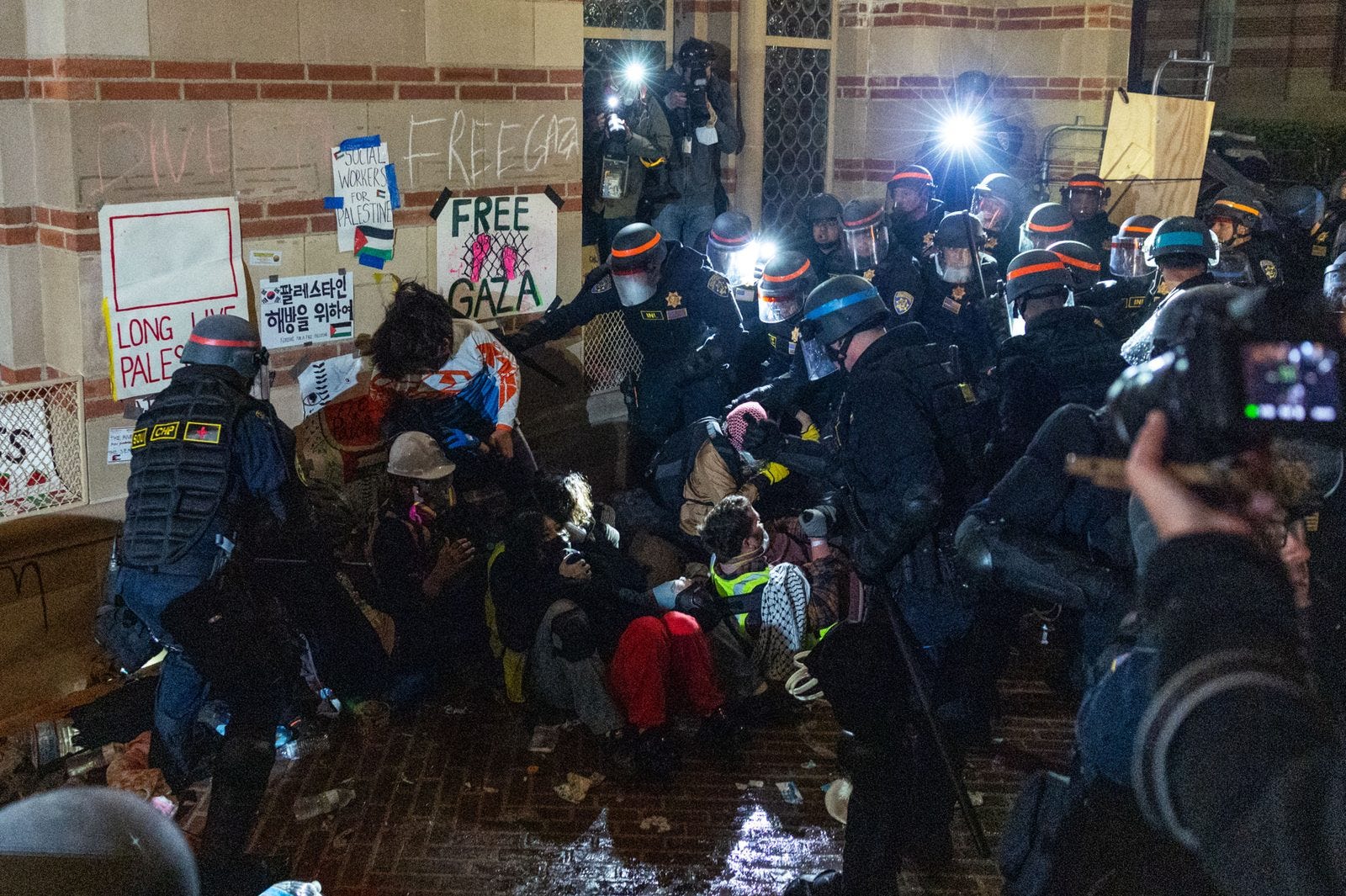
In the last three years of genocide in Gaza, 95% of its universities have been deliberately blown up. UNESCO presented a comprehensive assessment: 22 campuses out of 38 are completely destroyed, and 1,112 staff members (including 345 female staff) have been killed, detained, or injured.1 It is no surprise that this US-Israeli violence has boomeranged back onto American campuses. It started with the high-profile Congressional hearings in December 2023, in which several leading university leaders got raps on their knuckles for alleged antisemitism, even as the real price was paid by several brilliant, pro-Palestinian faculty who were surveilled, targeted, maligned, and even lost their jobs.
A few months later, student revolts began and encampments sprang up across 60 American campuses, eventually spreading to Canada, the UK, Europe and Australia. Thousands of students were beaten, assaulted and arrested as police were given a carte blanche by university administrators. Countless undergraduates and graduate students had their degrees withheld or their visas canceled, and some were even expelled. This savage attack on academia was abetted by Joe Biden and Kamala Harris, and laid the groundwork for Trump to come in and decimate whatever semblance of dignity that American universities might have retained.
The student protests exposed universities as glorified hedge funds with investments in weapons-related industries directly tied to the slaughter of people, in Gaza and elsewhere. Not only were universities’ hands dirtier than was previously known, but the clamping down on protests drew back the curtain on the ways in which education and curriculum had been manipulated to serve American empire. Professors, scholars, programs, events, syllabi and entire departments were persecuted and shut down as retribution for the faintest whiff of Palestinian solidarity. Soon, international students were being denied visas en masse and campuses turned into stomping grounds for ICE militias. Everything is now tainted: the idyllic American campus with its freshly cut lawns, the array of exciting majors, the shine of Ivy League prestige, and all that upright talk of free speech, diversity, anti-racism and other lofty notions that accompanies higher education. Several people I have spoken to recently are feeling a real sense of despair as their kids come of college age. Those who don’t live in the US but had harboured hopes to send their kids to US universities have decided against it. It is, in their minds, simply too dangerous.
But the unraveling of American universities has been a long time coming. Various scholars and historians will point to different points of origin, but my understanding of what went wrong begins with the end of World War II and the start of the Cold War. Universities became active participants in the Cold War and poured huge sums into the research and development of innovative, barbaric weaponry. Academics were thrown into witch-hunting Senator Joseph McCarthy’s line of fire. Various area studies units operated as surveillance outposts across Asia, Africa and the Middle East. Student unions and student protests were regularly infiltrated. And with the onset of the Vietnam anti-war protests, students were actually killed on campus. I wrote about the Cold War universities, and specifically about the role of English departments in all of this, in my book, Cold War Assemblages; Decolonization to Digital (2019), but I was only led to research this history because of everything I personally experienced after 9/11.
The events of 9/11 coincided with the start of my PhD in Comparative Literature at the City University of New York. Within days of the attacks, I encountered all kinds of racism from strangers that I could brush off. What shocked me especially were the kinds of things some of my grad school professors were saying. At one professor’s fancy Manhattan penthouse gathering for my cohort, a group of literature professors spoke passionately about how Afghanistan had to be nuked. Soon, this open prejudice and bloodlust for Muslims began to flow into the coursework and curricula. Many of us were discouraged from pursuing certain topics, or told that our credits for Middle Eastern literature courses would not count towards the degree. Outrageous comments were often made in class about Muslim philosophers, writers and scholars.
Within a month of 9/11, the US government signed in The Patriot Act, which meant anything and everything, it seemed, could be construed as terrorist activity. At universities, libraries flagged anyone checking out “suspicious” books, and organizations like Campus Watch sprang up, encouraging students to spy on scholars and professors of Middle East studies, while all kinds of dossiers on students and professors were compiled. Everything seemed in turmoil as the US beat the drums of war and prepared to invade Afghanistan and Iraq.
It has taken me years to unpack and process just how much damage was done to American universities during those post-9/11 years. My trip down memory lane was precipitated by the 25-year commemoration of 9/11 and a conversation with my dear friend Zohra Saed, who bore the brunt of that day over the years that followed simply because she was Afghan-American. On the one hand, she experienced racism and hostility, but on the other, she was targeted for lucrative offers by the US government to go to Afghanistan under the guise of helping, while in reality, the job would have been to embed herself in the heart of empire and become a collaborator in what she calls “the bait and switch scam of Afghanistan.” Here’s our lovely conversation:
29. Becoming Afghan, Becoming American After 9/11: Featuring Zohra Saed

“You had to go and perform Afghan-ness,” scholar and poet Zohra Saed recalls as she speaks of the scary and difficult days soon after the towers fell in New York City. Afghanistan was suddenly in the spotlight as the location of 9/11 mastermind and head of Al Qaeda, Osama Bin Laden.
As we watch American universities on the brink of ruin today, capitulating to power and laying prostrate before a corrupt government, the political spinelessness, and the desire to self-sabotage is shocking. The echoes from those 9/11 days are resounding. The seeds were sown a long time ago but they were really nourished after 9/11 and today, we can see how poisonous the fruits are.
Talking to Zohra reminded me that even as so much came undone, we collectively built so much too. Many of my conversations from the last year highlight this worldmaking project especially as discontent with American academia only grows. I have organized these conversations and articles in a section called Undisciplined: Notes on Carceral Academia. It features interviews with Huda Fakhreddine, Maura Finkelstein, Ammiel Alcalay and Sara Ahmed but also my longer article on UConn where I worked as tenured faculty for over a decade until I was pushed out.
There is, without doubt, plenty to feel wretched about especially as Palestinians continue to be slaughtered everyday while news of US sending Israel 2000-pound bombs lights up our screens. But it is still a monumental development that we can see everything laid out so clearly. Palestine is not only a litmus test anymore, it is more like an X-ray that is showing us the insides of the beast.
Love and solidarity❤️🔥
Bhakti Shringarpure
"With Gaza, we are beyond the breaking point." - Huda Fakhreddine

I sat down for a long conversation with Huda Fakhreddine, a brilliant scholar and fierce agitator whose voice has been a source of enlightenment as the war on Palestinians and the simultaneous war on narrative about Palestine is being waged with savage intensity.
19. Poetry, Protest and Palestine: Featuring Ammiel Alcalay

In more than two dozen books spanning Iraq, Bosnia, Palestine and Vietnam, poet, translator and scholar Ammiel Alcalay has crystallized a piercing critique of American imperialism. He illustrates a commitment to places and people upon whom the bloody trail left by American excursions is inscribed, whether abroad or at home.
7. The Repression of Palestine on American Campuses: Featuring Maura Finkelstein

Anthropologist Maura Finkelstein had always incorporated Palestine in her university teaching and felt that, as an anti-Zionist, Jewish American academic, it was her moral obligation to do so. She knew well the type of repression and harassment that Palestinian academics experienced at US universities, but thought that being a Jewish scholar would likel…
UCop: A Small Town Tale of Big Cop Ambitions

The last 20 months of Israel’s genocide in Gaza and the protests that have followed have laid bare the workings, intentions and sheer violence that American universities are capable of unleashing on their own students and faculty. The prioritization of wealth, the embrace of border regimes, an illogical worship of Isra…
Carceral academia

Mahmoud Khalil, a former Columbia student who was one of leaders in the Palestine solidarity encampments on campus was arrested in his New York City home by ICE (Immigration and Customs Enforcement) officers, a unit overseen by the DHS (Department of Homeland Security). Two agents in plain clothes were let into the building by Khalil’s 7-months pregnant…
UNESCO presents the assessment of damage and reconstruction needs for higher education institutions in Gaza https://www.unesco.org/en/articles/unesco-presents-assessment-damage-and-reconstruction-needs-higher-education-institutions-gaza