


Palestinian writer Ghassan Kanafani’s novella Men in the Sun (1962) tells the story of three male migrant workers who are making a clandestine journey to Kuwait by hiding inside the empty water tank of a truck. When they are almost at their destination, the truck’s driver, Abul Khaizuran, is held up for a long time at a bureaucratic checkpoint. The stifling midday heat descends, and the metal water tank in which the men are hiding gets unbearably hot. It takes a long time for the driver to leave the checkpoint, and upon driving off, he discovers that the three men have died of heat inside the tank. Abul Khaizuran discards their corpses and gives in to his grief about how the tragic events unfolded. The novella ends with his refrain: “Why didn’t you bang on the walls of the tank? Why didn’t you say anything? Why?”
The ending of Men in the Sun has endured in political and literary debates because of Abul Khaizuran’s insistence that the Palestinian men trapped inside the tank did not protest their fates. They did not try to be heard. On one side is the literal interpretation of the ending: The Palestinians in the tank did not protest. On the other, there is the notion that they screamed out their agony and banged on the walls of the water tank, but their screams were deliberately ignored in the way Western governments, international media and neighboring Arab nations have historically done.
In his more recent book, titled Banging on the Walls of the Tank: Dispatches from Gaza, Haidar Eid explains: “‘Banging on the walls of the tank’ has become one of the most loved metaphors in Palestinian discourse of resistance. It is a reference to making noise in order to be heard, to draw the attention of the world to one’s suffering caused by imperialist powers, in general, and Israeli colonization of Palestine, in particular.” But Eid also sees the inherent problem in this: “We are aware of the fact that we are the centre of so much attention, yet, ironically, we are never heard from.”
With the Gaza genocide ongoing for the last three years, it has become abundantly clear that Palestinians have told their stories, represented themselves and documented their own suffering with ferocious dignity, and at the highest possible volume. Compared to previous years, the Palestinian cause might be more popular than ever, but it is hard not to notice that big, Western, mainstream amplification of the Palestinian cause only comes when the Palestinian experience is filtered through the perspectives of progressive and anti-zionist Jews, dissident Israelis and white people.
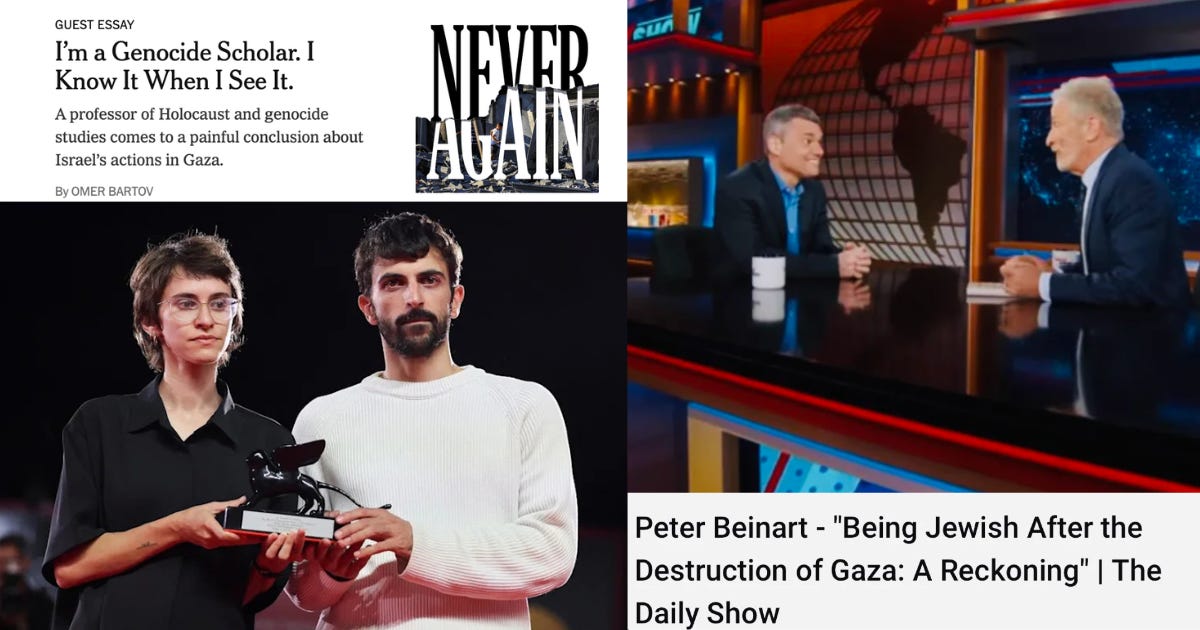
Israeli filmmaker Yuval Abraham, who is the co-director of two recent, celebrated films - NAZA and No Man’s Land - is more likely to skyrocket into the mainstream media realm (even if it is in the form of a controversy) than groundbreaking Palestinian filmmakers like Annemarie Jacir or Cherien Dabis. The New York Times is always a reliable testing ground: Only the Israeli-American historian Omer Bartov was allowed to sound the alarm and use the word “genocide” in the pages of “the paper of record.” Pro-Palestine Jewish American writer-artist Molly Crabapple’s book, Here Where We Live Is Our Country: The Story of the Jewish Bund, was reviewed in the NYT but many Palestinian writers with the same exact politics and same level of talent are ignored. Meanwhile, multiple Palestinian human rights organizations and think tanks have documented torture and other atrocities in Israeli prisons, but the only report given mainstream media credibility is the one by B’Tselem: Israeli Information Center for Human Rights in the Occupied Territories. Jewish-American writer Peter Beinart was invited by talk show host Jon Stewart to discuss his book Being Jewish After the Destruction of Gaza: A Reckoning, but hardly any Palestinians have made it into Stewart’s studio. Talks, events and podcasts with outspoken figures like Normal Finkelstein, Gabor Maté and Francesca Albanese can rack up hundreds of thousands of views in minutes and command more attention than most Palestinian experts and intellectuals.
Examples abound, and as I accumulate them here, I want to be clear that I feel nothing but profound gratitude for all these writers, artists, thinkers and activists. Without a doubt, their contribution and fierce advocacy is indispensable to the cause of Palestinian liberation. Almost all of them have paid a heavy price for being outspoken, and continue to be harassed for their every move. It is the media ecosystem, and this strand within the public discourse that turns a deaf ear to Palestinian voices, that I want to place under the microscope.
It became clear within days of the Hamas attacks of October 7th that Israel was going to brutally fast-track its ethnic cleansing of Palestinians, which has been going on for a century. Gaza had already been functioning as besieged enclave for many years by then, under an unrelenting blockade. The Israeli bombings and strikes after the attack were suddenly so numerous and shocking that many who had not engaged in these conversations before were suddenly pushed into thinking about it. And those who had always been part of advocating for Palestine had no choice but to take on the labor of informing and educating this curious but undecided sector as Israeli and Western propaganda against Palestinians hit an immediate pitch point. Doctored reports, a mass rape hoax, stories of beheaded babies, and an extraordinary revisionist history oozed out of newspapers, politicians, TV and social media accounts.
A reliable teaching tactic in those early days was asking the “undecided” to listen to or read what I will call “conversion narratives.” Recited by someone of Jewish faith, or from someone who grew up in Israel, these spoke of an early indoctrination into the Zionist project and how much they initially believed in Israel. But over time, either through a singular incident of awakening, or through a phase of learning against the grain, these figures converted to sympathy with the Palestinian cause. They finally understood the harm that Israel was doing to Palestinians, historically and now. They were just like you - but now, they have converted to the other side. These narratives often emphasized that becoming anti-Israel or anti-zionist did not mean giving up on being Jewish.
Another narrative that served as a teaching tactic, but also functioned as a declaration, was referred to as “Not in my name.” Reminding the undecided ones about the particular Jewish responsibility as survivors of the Holocaust, these stories insisted that the Jewish community must resist a genocide taking place in their name, and that the history of the Holocaust must not be appropriated to justify Israel’s actions in Gaza. “Not in my name” became a declarative hashtag and continues to be seen on posters in pro-Palestinian protests.
Palestinians, meanwhile, began to document the genocide on social media. Palestinian journalists, health workers, writers and scholars offered political analyses, historical explainers and poignant correctives to Western reporting and Israeli propaganda. These works were usually published by smaller indie platforms, or lived only on social media. It became clear quite quickly that powerful mainstream media would only repeat Israeli propaganda, and sometimes simply cut and paste IDF press releases. Somewhat bigger Arab or Arab-adjacent, English-language news outlets like Al Jazeera, Middle East Eye or Middle East Monitor were dedicated to reporting on Gaza, and many viewers came to rely on a handful of these organizations for transmitting Palestinian voices. A few progressive Western outlets like Democracy Now and Mondoweiss also became trusted sources that carried Palestinian perspectives and voices.
I noticed yet another strange trend when it came to sharing Palestine-related news and articles with friends, family or on one’s private social media accounts. Many would insist on only sharing or forwarding coverage from non-Arab sources which left them with places like Democracy Now or Mondoweiss, anti-zionist Jewish organizations like Jewish Voice for Peace or Jewish Currents, or the occasional mainstream media op-ed on Gaza. Articles from the English-language, liberal Israeli newspaper Haaretz also saw a huge spike in viewership and sharing. The logic was simple: sharing articles that did not have an Arab, Muslim or Palestinian stamp was more conducive to converting an undecided Western person to understanding and empathizing with Palestinian suffering.
Jewish supremacy and white supremacy are building blocks of the Zionist settler state of Israel, and European and North American allies are precisely invested in upholding these ideologies. Voices that emerge from within the heart of this project play an important role in dismantling it; especially those stories that can offer insights into why they were captivated by it all and what brought about a change of heart. There are historical precedents. American soldier narratives that spoke out against the Vietnam war were instrumental in causing a shift in public opinion. Robin DeAngelo’s book White Fragility was published in 2018, but became a phenomenal success after the murder of George Floyd in 2020. A white author’s book that speaks honestly about her own race privilege played a key role in white America’s reckoning with anti-Blackness despite a hundreds of years of Black writers calling out structural racism in American life.
When it comes to Palestine, the battle lines have become clearer over the last three years, but a preoccupation with the converted and progressive perpetrator story is still very much in play. It is a logic that does not fail to confound me. Jewish, white and Western perspectives are seen as impartial and rational, whereas Palestinian or Arab perspectives, especially dispatches from the ground, are considered biased. Palestinians cannot see anything but their own experience. Palestinians cannot see both sides of this complex conflict. Palestinians cannot articulate it without getting too emotional. Palestinians have too much at stake in the narrative they are recounting. And even if every single allegation is true, it is incomprehensible to me why that would be grounds to dismiss Palestinian voices. The extraordinary reserve of racism and Islamophobia at the core of these assumptions has been honed over centuries, and not even a genocide seems to be changing that.
As Palestinians contend with their own extermination, it is no surprise that their voices have gotten louder. Yet, the big mainstream coverage, big events and big podcasts are reserved for those who are not Palestinian. When it comes to awards and acclaim, the West rewards very little that is produced by Palestinians. Sadly, this is apparent even on a smaller scale. The Palestine Book Awards is in its tenth year and awards books about Palestine written in English. They have received an astounding 80-plus book submissions, but their shortlist features very few Palestinians. This proves that English-language book publishing about Palestine is on the rise and is potentially even profitable - so long as it is not dominated by Palestinians.
In 1988, theorist Gayatri Chakravorty Spivak wrote an essay that resonated across several academic fields from history to literature to anthropology. Titled “Can the Subaltern Speak?” Spivak asked why the subaltern—a marginalized and oppressed person or group excluded from circuits of power—is unable to represent themselves or speak up. This is because, even they do, their voices are mitigated and diluted to the point of erasure, and the subaltern is thus cast out of history itself. Spivak doomfully concludes that the subaltern cannot speak but she never claims that the subaltern does not have the ability to speak. Speaking is rendered futile without a listener. Thus the blame has always been pointed at the listener, and even more so at the wilfully deaf who actively refuse to hear.
Palestinians are speaking more than ever, but a determined refusal to listen to them still remains the norm. The cost of the West’s wilful deafness is extremely high - literally a matter of life and death for Palestinians. Palestinian intellectual Edward Said explained it perfectly: “The power to narrate, or to block other narratives from forming and emerging, is very important to culture and imperialism, and constitutes one of the main connections between them.”
Love and solidarity❤️🔥
Bhakti Shringarpure
Recently on the Radical Books Collective
“I had been deceived by the practice of journalism.” - Joe Sacco

Joe Sacco’s book Palestine: A Nation Occupied was my first true immersion into the history of Palestine. Over two and half decades later, I was overjoyed and honored to speak with him for the Radical Futures podcast. He spoke about his heartbreak over Gaza, his disillusionment with American journalism, his recent brush with censorship in India, and his …
29. Becoming Afghan, Becoming American After 9/11: Featuring Zohra Saed

“You had to go and perform Afghan-ness,” scholar and poet Zohra Saed recalls as she speaks of the scary and difficult days soon after the towers fell in New York City. Afghanistan was suddenly in the spotlight as the location of 9/11 mastermind and head of Al Qaeda, Osama Bin Laden.

Who judges for the palestine book awards? Which 🇵🇸 authors have been shortlisted?