


We are proud to publish Sherry Zane’s comprehensively researched essay about the most famous man on our planet and a global phenomenon in life and death: Michael Jackson. The marketing for the upcoming biopic Michael started over two years ago, and it’s working. Social media has been flooded with his songs and clips. Even those born after Jackson’s death suddenly claim to know his music. But the fact that this marketing saturation occurred at a time when the internet has also been flooded with news from Gaza led to a shocking discovery: Michael Jackson once wrote a song about Palestine. But it remained unrecorded.
Michael Jackson, Palestine, and the Erasure of Solidarity

A few months ago, my Instagram feed lit up with a surprising piece of news about the late Michael Jackson. On his return flight from a 1993 concert in Tel Aviv, Jackson had written a song called “Palestine, Don’t Cry.”
The song, titled “Palestine, Don’t Cry” and penned on airplane stationery, did not come from nowhere. In the third week of September 1993, Jackson performed two concerts in Tel Aviv, mere days after the Oslo Accords between Israel and the Palestine Liberation Organization (PLO) were signed. Accounts of Jackson’s time there are varied, and his views about it blurry. Zane’s essay, a precursor to a book, argues that fog, blurring and rumors were typical of the ways in which Michael Jackson’s political positions were managed and controlled over a wide range of issues, from racism to the environment, violence and, certainly, the Middle East.
The essay shows how solidarities held and expressed by the most visible man in the world were made invisible, time and again. Zane writes: “The establishment resisted the idea of a Black global figure mobilizing grief, recognition, and care on his own terms. These moments do not reveal inconsistency in Jackson’s ethics; they show how quickly solidarity becomes threatening when it reaches millions.”
But Zane also recounts Jackson’s brilliant, strategic ways of tricking those who sought to control him and remaining firm on his beliefs.
There’s no doubt that Michael Jackson’s music reached far and wide, including in the Muslim world. In 2004, my friend and I were traveling by car through remote areas of Morocco’s Atlas Mountains. We made a pit stop by a crumbling roadside stall, and a little boy, no older than nine, serenaded us with a Michael Jackson tune and insisted we buy a Michael Jackson CD from the handful he was selling. This is before the time of social media and widespread wifi connections; the music had traveled here by the sheer force of Jackson’s influence. In India, where I grew up, Jackson’s music was beloved, his choreography was mimicked in Bollywood movies and by street impersonators, and his music videos were received as peak innovation in a film-mad country. Of course, a kid in rural Morocco would know of Michael Jackson. We got in the car and drove off, amused but unaffected.
But thinking back to this moment now, I realize how little we actually know about Jackson’s relationship to the Muslim world. Zane’s eye-opening essay takes “Palestine, Don’t Cry” as a point of entry is a great start. Certainly, in Palestine, he lives on👇🏾
Love and solidarity ❤️🔥
Bhakti Shringarpure
Recent publications and podcasts
Palestine at the Movies: A Triptych

Three powerful Palestinian films have pierced through to the public imagination this past year: Palestine 36, All That’s Left of You, and The Voice of Hind Rajab.
Ep 32. Backtracking on Palestine? Zohran Mamdani and the Democratic Party Playbook
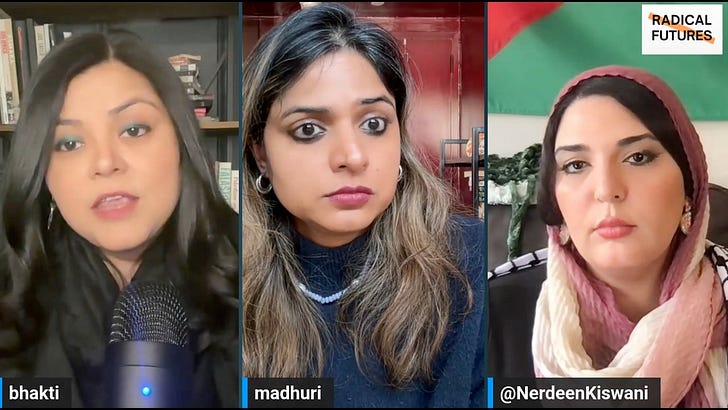
Palestinian American activist Nerdeen Kiswani joins Bhakti Shringarpure and Madhuri Sastry to discuss the recent concerns about NYC Mayor Zohran Mamdani backtracking on Palestine. In light of Mayor Mamdani’s harsh words about writer Susan Abulhawa and her powerful video response, the fear of betrayal around Palestine looms large, a core issue for the ba…
Ep 31. Are The Oscar Films Too Political This Year?

Bhakti Shringarpure and Madhuri Sastry hosted a pre-Oscars film club. They admit that there have been lots of surprises in the mainstream blockbuster film industry this year. The discussion focused on films about revolution (One Battle After Another,
The other day, "Man in the Mirror" came on the radio as I was driving and I sobbed quietly, remembering the imagery with this song and thinking of the murdered Iranian school girls, teachers and administration. Such a powerful song.